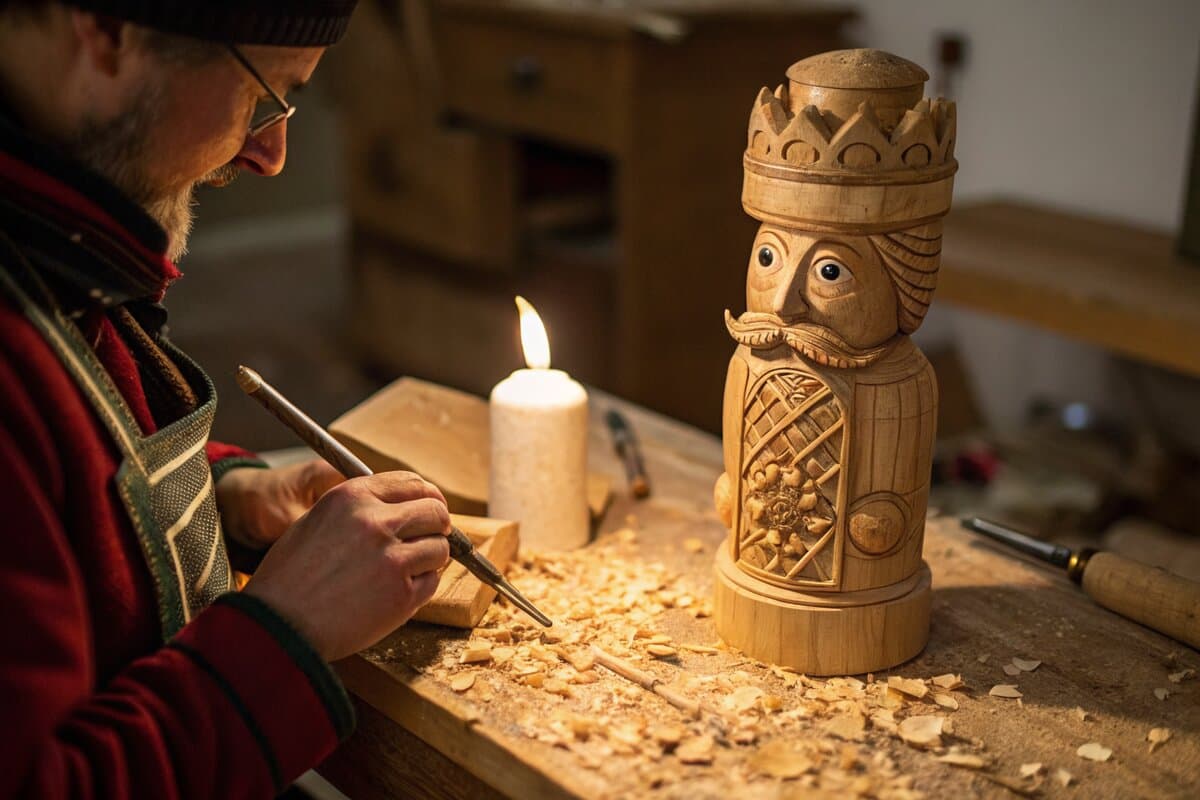
The block of linden sits on the workbench. It is roughly the size of a man's forearm -- thirty-eight centimeters long, perhaps twelve in diameter, cut from a log that was felled the previous winter and air-dried for at least twelve months. The bark was stripped long ago. What remains is a cylinder of pale, cream-colored wood with a grain so fine it is nearly invisible. This is Tilia cordata -- small-leaved linden, also called limewood or basswood -- and there is a reason it has been the carver's wood of choice in the Erzgebirge for three centuries.
Linden is soft. Not weak -- there is a difference. It carves cleanly under a sharp gouge, accepting the tool without splitting or tearing. It holds detail: the fine lines of a mustache, the individual teeth of a crown, the shallow relief of a coat button. And it is stable. Once dried properly, linden does not warp, does not crack, does not move with the seasons the way oak or ash will. A nutcracker carved from well-seasoned linden and stored in reasonable conditions will hold its shape for a hundred years.
The carver knows this. He has known it since his apprenticeship, which began when he was fifteen and lasted four years. He does not think about the wood's properties as he selects the block. He feels them -- in the weight of the piece, in the sound it makes when he taps it with a knuckle (a dull, dense thud means dry and ready; a higher pitch means moisture remains), in the way the surface accepts the first shallow test cut of his gouge.
The block passes inspection. The carving of the Konigstein begins.
The Design
The Konigstein -- the King's Stone -- is one of the traditional nutcracker archetypes of the Erzgebirge. It is not a specific model but a family of designs: the regal nutcracker, crowned and robed, standing with the authority of a monarch rather than the stiffness of a soldier. Where the soldier nutcracker is upright and martial, the Konigstein carries a bearing of composed dignity. The jaw is strong. The eyes are wide. The crown sits heavily on the head, as if the figure understands the weight of what it represents.
Every carver has his own interpretation of the Konigstein, shaped by the workshop tradition he inherited and the decades of repetition that have made the design his own. The proportions, however, follow established conventions. The head accounts for roughly one-third of the total height -- exaggerated compared to human anatomy, but essential to the nutcracker's character. The body is a broad, stable cylinder. The base is flat and wide enough to provide stability. The arms, if separate, are short and held close to the body.
The carver does not work from a drawing. He works from memory, from the thousands of Konigstein figures he has carved before this one. His hands know the proportions the way a pianist's hands know an octave -- not through measurement but through repetition so deep it has become instinct.
The Lathe
The first tool is not a carving tool at all. It is the lathe.
The linden block is mounted between the lathe's headstock and tailstock, centered as precisely as the carver's eye can manage. The lathe spins the wood at several hundred revolutions per minute, and the carver holds a turning gouge against the spinning surface, shaping the cylinder into the rough profile of the nutcracker's body.
This is called roughing out, and it is the fastest step in the process. In fifteen to twenty minutes, the featureless cylinder becomes a recognizable form: a rounded head sitting atop a tapered body, with the beginnings of a base at the bottom. The transition from head to body -- the neck -- is cut as a shallow groove. The base is flattened. The overall silhouette is established.
What the lathe produces is a shape, not a figure. It has no face, no arms, no detail. It looks like a large chess pawn. But within this pawn, the carver already sees the king. The proportions are committed. The height is set. From this point forward, everything is subtraction -- removing the wood that is not the Konigstein.
The Jaw
The jaw mechanism is what makes a nutcracker a nutcracker. Without it, the figure is decoration. With it, the figure has purpose.
The jaw is cut before any detail carving begins, because it requires the most precise work and any error at this stage ruins the piece. The carver removes the block from the lathe and secures it upright in a vise. Using a coping saw, he makes two parallel cuts across the face of the figure, defining the upper and lower boundaries of the mouth opening. A third cut removes the waste wood between them, leaving a rectangular slot.
Into this slot, the lower jaw will fit. The jaw itself is a separate piece, carved from a block of the same linden, shaped to match the width of the mouth opening. At its rear, the jaw has a protruding tang that passes through the back of the head and connects to the lever mechanism.
The lever is the simplest machine in the nutcracker's anatomy. It is a rigid arm -- wood or metal -- that pivots on a pin inserted through the back of the head. When the lever's upper end is pressed, the lower end pushes the jaw's tang forward, closing the mouth. When the lever is released, a small spring or the natural tension of the wood returns the jaw to its open position.
The pivot point must be exact. Too high, and the jaw will not close fully. Too low, and the mechanical advantage is lost -- the lever will require too much force, or the jaw will close with too little grip to crack a nut. The carver drills the pivot hole with a hand drill, checking the alignment by inserting a test pin and manually operating the jaw before committing to the final assembly.
In traditional workshops, the jaw mechanism is tested with an actual walnut. If the nut cracks cleanly, the mechanism is sound. If it does not, the carver adjusts. This is the standard. It has not changed.
The Gouges
With the jaw mechanism roughed in and tested, the detail carving begins. This is where the lathe's work ends and the hand's work begins.
The carver's primary tools are gouges -- curved chisels of varying widths and sweeps (the degree of curvature). A typical Erzgebirge carver works with fifteen to twenty gouges, ranging from a flat chisel for smoothing surfaces to a deeply curved veiner for cutting fine lines. The gouges are driven by hand pressure alone -- no mallet. The linden is soft enough that a sharp gouge, pushed with the heel of the palm, moves through the wood with a quiet, clean sound, producing a thin curl of shaving that falls to the bench.
The face comes first. The carver defines the brow ridge -- a strong, horizontal line that gives the nutcracker its perpetual expression of stern attention. Below the brow, the eye sockets are cut with a small gouge, creating shallow depressions that will later be painted to suggest wide, round eyes. The nose is left proud -- a triangular ridge between the eye sockets that gives the face its center.
The mustache is carved in relief, curling outward from the upper lip. In the Konigstein tradition, the mustache is full and upswept, a mark of authority. The carver uses a V-gouge to cut the separation between the two halves of the mustache and a shallow gouge to shape the curves. This is work measured in millimeters. A slip of the tool here can change the figure's expression from regal to comical -- or ruin the piece entirely.
The crown is carved from the top of the head, cut in situ from the same block. The carver defines its peaks with a coping saw, then refines each peak with a gouge, giving them the slight irregularity that distinguishes hand carving from machine work. A Konigstein crown typically has five points, though variations exist. The interior of the crown -- the band that wraps the head -- is scored with shallow lines to suggest jewels or embossing.
The body receives less detailed carving than the head. The coat is defined by shallow relief lines at the hem, the cuffs, and the collar. Buttons may be suggested by small circular cuts. The epaulets -- if the design includes them -- are carved as raised pads on the shoulders. The overall effect is of a figure wearing a uniform that is suggested rather than described: enough detail to establish character, not so much that it competes with the face.
The Assembly
The arms are carved separately -- two small pieces of linden, each shaped to suggest a bent arm with a gloved hand. They are attached to the body with small wooden pegs, glued and inserted into pre-drilled holes at the shoulder. The pegs are tight enough to hold without clamping, and the glue -- traditionally a hide glue, though modern PVA is now common -- sets overnight.
The jaw mechanism receives its final assembly: the jaw piece is fitted, the lever is pinned in place, and the operation is tested again. The carver opens and closes the jaw dozens of times, feeling for smooth action, checking for lateral play, ensuring that the lever returns to its resting position without sticking.
The base, if not already turned on the lathe, is shaped and attached. In some traditions, the base is integral -- turned as part of the original cylinder. In others, it is a separate disc of linden, glued to the bottom of the figure and sanded flush.
The assembled figure is sanded lightly -- not to remove the gouge marks entirely, but to soften them. A traditionally carved nutcracker retains the subtle faceting of hand work. It is not smooth in the industrial sense. It is smooth in the sense of a river stone: shaped by a process that leaves its evidence.
The Painting
The figure passes from the carver to the painter -- or, in smaller workshops, the carver sets down his gouges and picks up a brush.
The painting of a Konigstein follows conventions that are specific enough to be recognizable and flexible enough to allow individual expression. The face is painted first: a flesh tone base, then the eyes (wide, round, typically blue or brown, with a sharp white highlight that gives them their characteristic stare), then the mouth (red, with the lips clearly defined around the jaw opening), then the details -- the eyebrows, the cheek color, the fine lines that suggest the mustache's texture.
The crown is gilt -- painted with gold paint or, in finer pieces, with gold leaf applied over a layer of sizing. The coat receives its color: deep blue, rich red, forest green, depending on the workshop's tradition. The buttons and epaulets are picked out in contrasting colors. The hands are painted to suggest white gloves. The base may be painted black or left as natural wood with a clear finish.
The final element is the hair and beard. In traditional production, these are made from rabbit fur -- short, dense, and slightly curly, which closely resembles the texture of human hair at the nutcracker's scale. The fur is cut to shape, glued to the appropriate areas of the head and chin, and trimmed with small scissors until the carver is satisfied with the silhouette.
The beard is what completes the figure. Without it, the Konigstein is a painted carving. With it, the Konigstein is a presence -- a figure that exists in the space between object and character, between wood and personality.
The Finished King
The Konigstein stands on the workbench. It has taken between eight and twelve hours of labor, spread across several days to allow for drying between steps. It weighs perhaps four hundred grams. Its jaw opens and closes. Its crown catches the workshop light. Its eyes stare forward with the expression that all traditional nutcrackers share -- that look of grumpy, steadfast, slightly absurd dignity that has made these figures beloved for centuries.
The carver examines it. He turns it in his hands, checking the paint, testing the jaw one final time, running a thumb along the crown's peaks. If he is satisfied -- and his standard is exacting -- he sets it aside with the others. Tomorrow, or the next day, he will begin another.
This is the craft. Not a single moment of inspiration, but a practice -- repeated, refined, and honored through the labor of doing it again. Each Konigstein is the same design. None are the same figure. The difference is the hand that made it.
A nutcracker carved by hand carries something a factory cannot replicate. Not just the marks of the chisel, but the patience of the person who held it. That is worth protecting.