The earliest nutcrackers of the Erzgebirge were not kings. They were not officers, not hussars, not the regal figures that fill collectors' shelves today. They were soldiers -- common foot soldiers, the lowest rank in a rigid hierarchy -- and the choice was deliberate.
To understand why, you must understand who made them and what they meant.
The miners of the Erzgebirge, who turned to woodcarving when the silver and tin began to run out in the 17th and 18th centuries, lived under a system of authority they had no power to challenge. The mine owners, the tax collectors, the local nobility, the military officers billeted in their villages -- these were the figures who controlled the miners' daily existence. The nutcracker, with its oversized jaw and its single, repetitive function, was the miners' quiet revenge: a figure of authority reduced to cracking nuts. The soldier's stiff posture and exaggerated grimace were not reverence. They were satire.
This is the origin that gets lost in the modern appreciation of the nutcracker as a handsome collectible. The figure was born in mockery. Its jaw was a joke -- a powerful man whose only purpose was to serve the person holding him. The miners, who had spent their lives serving others, found something satisfying in the reversal.
But satire, if the object is good enough, has a way of becoming affection. And the nutcracker, over the course of three centuries, underwent a transformation as profound as any in Hoffmann's tale: it went from a joke to a symbol, from a servant figure to a guardian figure, from a common soldier to a king.
The First Soldiers
The earliest surviving nutcrackers from the Erzgebirge date to the late 18th century, though folk tradition places their origins earlier. These early figures are simple: turned bodies, flat-carved faces, minimal painting. The uniform, where one exists, is generic -- a suggestion of military dress rather than a reproduction of any specific regiment's livery.
The proportions are distinct from what came later. The early figures tend to be squatter, with shorter bodies and proportionally larger heads. The jaw mechanism is crude but effective -- a simple lever, often made from a strip of iron rather than wood, operating a lower jaw that is blocky and unrefined. These are working tools. Their makers were not concerned with display. They were concerned with function, and the function was cracking nuts.
The soldier uniform in these early pieces reflected the immediate reality of the carvers' world. Saxony, where the Erzgebirge sits, maintained a standing army throughout the 18th century, and soldiers were a constant presence in the mining towns. The choice to dress the nutcracker as a soldier was natural -- it was the uniform the carvers saw daily, the figure of authority most immediately present in their lives.
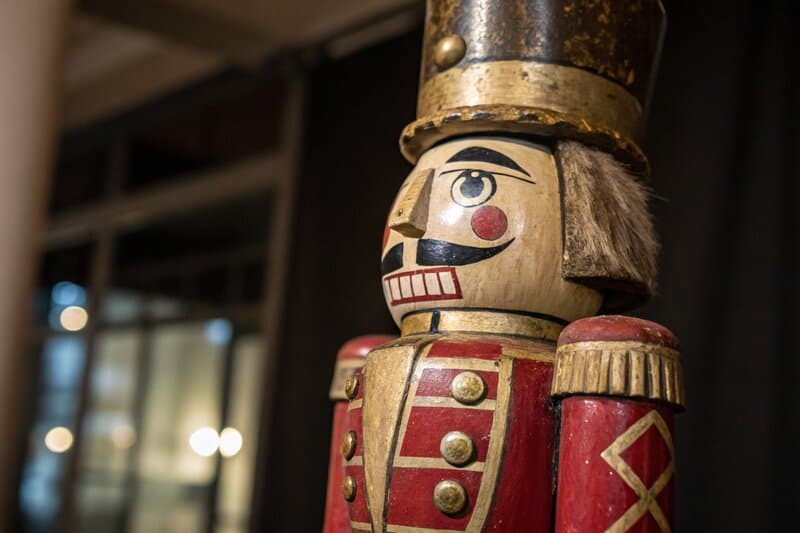
The standard soldier nutcracker wore a simple coat (usually blue, the color of the Saxon infantry), white crossbelts, a flat-topped shako or simple helmet, and tall boots. The face was severe -- wide eyes, drawn brows, a prominent jaw. There was no attempt at friendliness. The soldier nutcracker was meant to look imposing. The humor was in the imposition's futility: here is a fierce soldier, and his only battle is with a walnut.
The Rise of the Officer
By the early 19th century, the nutcracker had begun to climb the ranks.
The shift from common soldier to officer coincided with two developments. The first was commercial: as the Erzgebirge workshops expanded their markets beyond the local Christmas markets to broader trade networks, the nutcrackers became more elaborate. Buyers in Leipzig, Dresden, and eventually Berlin were willing to pay more for figures with greater detail and more impressive uniforms. An officer sold for more than a soldier. A general sold for more than an officer.
The second development was cultural. The Napoleonic Wars (1803-1815) had swept through Saxony, and the military officer had become a figure of both fear and fascination. The wars left a deep imprint on Erzgebirge culture -- many miners were conscripted, and the devastation of the campaigns shaped the region's collective memory for generations. The officer nutcracker that emerged in this period reflected a complex attitude: admiration for military bearing, resentment of military authority, and the persistent folk tradition of using the nutcracker to cut both down to size.
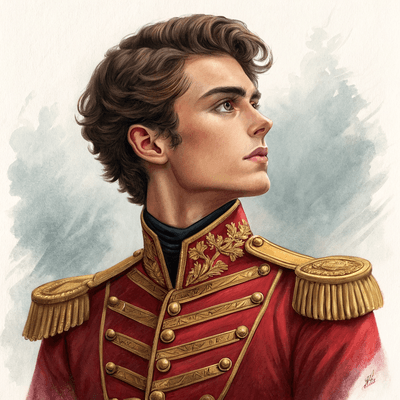
The officer figure introduced new elements to the nutcracker's design. Epaulets appeared on the shoulders -- carved in relief or added as separate pieces. The coat became more detailed, with painted buttons, piping, and braiding. The headgear evolved from the simple shako to more elaborate forms: plumed helmets, fur busbies, and eventually the tall, feathered shakos associated with Prussian officers. The sword, carried in one hand, became a standard accessory.
The face changed too. Where the common soldier had looked fierce and somewhat simple, the officer's expression carried a suggestion of intelligence -- or at least of self-importance. The eyebrows were set higher, the mouth more precisely defined. The officer was still a figure of fun, but he was a more dignified kind of fun.
The Hussar
Among the military types, the hussar nutcracker deserves particular attention, because it represents the moment when the craft crossed the line from functional satire to aesthetic ambition.
The hussar -- the light cavalry soldier, originally a Hungarian military tradition adopted across European armies in the 18th and 19th centuries -- wore the most ornate uniform in any army. The dolman (a short jacket with braided frogging), the pelisse (a fur-lined jacket worn over one shoulder), the busby (a tall fur hat), and the sabretache (an ornamental pouch) made the hussar the most visually spectacular soldier on the battlefield.
For the Erzgebirge carvers, the hussar was irresistible. Here was a uniform that demanded the full range of their skills: complex carving for the braiding and frogging, precise painting for the multiple layers of color, real fur (typically rabbit) for the busby and the pelisse trim. The hussar nutcracker became a showpiece -- the figure that demonstrated a workshop's capability.
The earliest hussar nutcrackers, from roughly the 1830s and 1840s, are among the most prized by collectors today. They are also, it should be noted, the most frequently reproduced -- often poorly. The hussar's complexity makes it a litmus test for workshop quality. A well-executed hussar, with its braiding neatly painted and its fur properly trimmed, is a statement of mastery. A poorly executed hussar, with sloppy frogging and ratty fur, is more embarrassing than a simple soldier done well.
The King
The king nutcracker appeared in the mid-19th century, and with it, the figure's transformation was complete.
The shift from military figure to monarch was gradual. Early king designs retained military elements -- the coat, the epaulets, the stiff bearing. What changed was the headgear: the military shako was replaced by a crown. And with the crown came a different kind of authority. The soldier derived his power from the army behind him. The king derived his power from himself. The soldier was a functionary. The king was a sovereign.
The crown changed the figure's entire bearing. A nutcracker wearing a crown did not need to look fierce. He needed to look certain. The expression softened -- not into friendliness, but into composed authority. The jaw remained prominent (it had to -- the jaw was the mechanism), but it was no longer a sign of aggression. It was a sign of judgment. The king cracked nuts not because he was strong but because he was decisive.
The Konigstein design, which I have written about elsewhere, is the fullest expression of this transformation. The Konigstein is broad, stable, and dignified. His crown is heavy. His coat is rich. His eyes are wide and watchful. He is not a soldier reduced to cracking nuts. He is a king whose function is, in some strange way, noble. He serves, and in serving, he retains his dignity.
This is the transformation that Hoffmann anticipated, even if the carvers arrived at it independently. In the original tale, the nutcracker is cursed -- transformed from a prince into a wooden figure. His redemption comes through love, through being seen for what he truly is beneath the wooden exterior. The king nutcracker is the visual fulfillment of that narrative: a figure that has transcended its origins, that has become something more than what it was made to be.
The Modern Proliferation
The 20th century brought an explosion of nutcracker character types that would have astonished the original Erzgebirge carvers.
After reunification in 1990, the workshops faced a new competitive landscape, and diversification was one response. Nutcrackers began to appear as chimney sweeps, bakers, hunters, wine growers, night watchmen, and forest rangers -- figures drawn from German folk tradition and regional occupations. Holiday-specific figures followed: the Weihnachtsmann (Father Christmas), the Raeuchermann-style smoking man adapted to nutcracker form, and figures based on characters from German fairy tales.
The late 20th and early 21st centuries brought a further expansion, driven largely by the American market's appetite for novelty. Nutcrackers now exist in the likeness of baseball players, firefighters, cowboys, chefs, and virtually every profession and hobby imaginable. Themed collections have become a commercial staple: Wizard of Oz nutcrackers, Dickens nutcrackers, Star Wars nutcrackers. The figure's basic form -- the lever jaw, the stiff posture, the painted face -- has proven remarkably adaptable to almost any character concept.
I observe this proliferation with mixed feelings. The traditionalist in me values the historical types -- the soldier, the officer, the hussar, the king -- for their connection to the craft's origins. The realist recognizes that commercial adaptation has kept the Erzgebirge workshops solvent. The workshops that produce baseball-player nutcrackers also produce traditional kings, and the revenue from the former often subsidizes the labor-intensive production of the latter.
What I find important is that the traditional types survive. Not as museum pieces but as living designs, carved and painted by craftspeople who understand their history and respect their conventions. A Konigstein carved today in Seiffen is part of an unbroken lineage that stretches back two centuries. The wood is the same. The tools are the same. The expression is the same. Only the hands have changed.
What the Uniform Means
Every nutcracker wears a uniform of some kind. Even the modern character figures -- the bakers and firefighters and baseball players -- are dressed in the distinctive clothing of their role. The uniform is intrinsic to the form. A nutcracker without a uniform is just a wooden figure with a lever jaw.
But the uniform means something different now than it did when the miners first carved it. The original soldier's coat was mockery. The king's robe is honor. The journey between the two -- from satire to dignity, from joke to heirloom -- is the story of a craft discovering what it could be.
The nutcracker began as a common soldier, cracking nuts in a miner's kitchen. It became a king, standing on a mantelpiece, watching over a family's Christmas. The jaw still works. The function has not changed. What has changed is what the figure represents: not the powerlessness of the person who made it, but the care they put into making it. Not authority imposed from above, but craftsmanship offered from hand to hand.
A nutcracker carved by hand carries something a factory cannot replicate. Not just the marks of the chisel, but the patience of the person who held it. That is worth protecting.