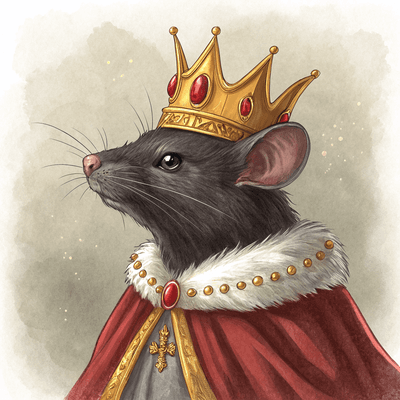
I have been defeated on stage approximately 14 million times.
That number is not precise -- nobody keeps official records of Mouse King casualties, which tells you everything about how this industry values its villains. But if roughly 3,000 productions of The Nutcracker are mounted each year across North America alone, and the ballet has been performed continuously since 1954 in its modern American form, the math gets into territory that I would find depressing if I were the kind of mouse who let numbers affect his self-worth.
I am not. But I do have opinions about how, exactly, I have been losing all these battles. Because not all defeats are created equal, and the way a production stages the battle scene reveals more about its artistic priorities than any press release or program note ever will.
Let me take you through the history. Chronologically. With commentary.
The 1892 Original: The Battle That Nobody Remembers
The first battle scene, staged by Lev Ivanov at the Mariinsky Theatre in St. Petersburg, was not really a battle scene at all. It was a pantomime.
This is a critical distinction that most Nutcracker histories gloss over. In the vocabulary of nineteenth-century Russian ballet, there was a clear division between danced passages and mimed passages. The character dances, the pas de deux, the variations -- these were composed of actual ballet steps. The narrative scenes -- the party, the gift-giving, the battle -- were largely pantomime: stylized gestures, theatrical movement, and acting that communicated plot without requiring classical technique.
Ivanov's battle was performed primarily by children from the Imperial Theatre School, supplemented by adult mimes in mouse costumes. The nutcracker and the Mouse King were pantomime roles, not dancing roles. The combat was theatrical rather than choreographic -- swords clashed, mice scurried, toy soldiers marched. But nobody was doing double tours or grand jetes during the fighting.
The original reviews barely mention the battle scene. The critics were more concerned with the lack of dancing in Act II than with the staging of Act I's climax. The battle was, by the standards of the 1892 premiere, a transitional scene -- necessary for the plot but not the point.
This would change.
The Soviet Era: Making It Mean Something
The battle scene's transformation from pantomime interlude to dramatic centerpiece began in the Soviet Union.
When the Kirov Ballet (the renamed Mariinsky) revised The Nutcracker in the 1920s and 1930s, the battle scene received new attention. Soviet cultural policy favored art with clear narrative purpose and ideological resonance. A battle between a wooden soldier and a tyrannical mouse king could be read -- if you squinted -- as a class struggle, an uprising of the oppressed against a crowned oppressor.
I find this reading personally offensive, but I acknowledge its historical influence.
Vasily Vainonen's 1934 production for the Kirov is the landmark Soviet Nutcracker and the version that shaped subsequent Russian productions for decades. Vainonen's battle scene was significantly expanded from the original, with more elaborate staging, more performers, and a more dramatic arc. Crucially, Vainonen made the battle danced rather than merely mimed. The toy soldiers and mice performed actual choreography -- martial in character, rhythmically driven, with formations and counter-formations that gave the scene a sense of genuine military conflict.
Vainonen also elevated the Mouse King from a pantomime clown to a legitimate dramatic presence. His Mouse King was physically imposing, moved with deliberate menace, and fought the nutcracker in a passage of choreographed combat that had real tension. The outcome -- the Mouse King's defeat -- was earned rather than inevitable.
This was, I will grudgingly admit, an improvement. Being taken seriously as a threat is better than being treated as comic relief.
Balanchine: The Battle as Spectacle
George Balanchine's 1954 production for the New York City Ballet is the Nutcracker that created the American tradition, and his approach to the battle scene defined how a generation of choreographers would think about the sequence.
Balanchine's battle is a spectacle. A big, loud, visually dense spectacle. His stage fills with children -- mice on one side, toy soldiers on the other -- in a melee that prioritizes theatrical excitement over choreographic precision. The mice scurry. The soldiers march. Cannon fire is simulated. The Christmas tree grows enormous above the chaos. The stage becomes a landscape of miniaturized warfare viewed from a child's perspective.
Balanchine understood that the battle scene's audience is, disproportionately, children. He staged it accordingly. The combat is broad, clear, and easy to follow. Good guys on this side, bad guys on that side. The Mouse King is big and scary but not too scary. Clara's intervention -- the slipper throw -- is highlighted as the decisive moment. The nutcracker's victory is swift and unambiguous.
Here is my critique, and I have been saving it: Balanchine's battle is entertaining but weightless. Nothing is at stake. The mice are a horde of costumed children who are clearly having the time of their lives. The Mouse King is defeated so quickly that his threat never fully registers. The whole sequence plays like a birthday party game -- exciting in the moment, forgotten by intermission.
Balanchine was a genius. But in this particular scene, his genius was deployed in the service of charm rather than drama. The battle is delightful. It is not dangerous. And a battle that is not dangerous is not really a battle.
Baryshnikov: The Made-for-TV Battle
The 1977 CBS television broadcast of the American Ballet Theatre's Nutcracker, with Mikhail Baryshnikov as the Nutcracker Prince, brought the battle scene to a mass audience for the first time. Directed by Tony Charmoli with staging input from Baryshnikov himself, this production made decisions about the battle that were driven as much by the camera as by the stage.
Television demands close-ups. Close-ups demand facial acting. For the first time, the Mouse King's face -- or rather, the performer inside the Mouse King costume -- had to convey something specific: menace, intelligence, personality. The camera pulled in tight on the confrontation between the nutcracker and the Mouse King, transforming a stage battle into a personal duel.
The result was surprisingly effective. The ABT battle scene is more intimate than Balanchine's, more focused on the one-on-one combat between the two principals. The toy soldiers and mice are present but secondary -- the frame keeps returning to the central confrontation. Clara's slipper throw is shot as a dramatic turning point, with a reaction shot from the Mouse King that borders on the sympathetic.
I appreciate this production. Not because it treats the Mouse King well -- it does not; I still lose -- but because it acknowledges that the battle is a duel between two individuals rather than a skirmish between two armies. That is closer to what Hoffmann wrote. Two figures, locked in a conflict that predates them both, fighting over a curse that neither of them chose.
Mark Morris: The Battle as Satire
Mark Morris's The Hard Nut, created in 1991 for the Mark Morris Dance Group, is the most radical reimagining of the battle scene in the Nutcracker's performance history.
Set in the 1970s rather than the 1800s, with a deliberately unglamorous aesthetic and a commitment to stripping away sentimentality, The Hard Nut stages the battle scene as something between a bar fight and a political protest. The mice are not cute and they are not scary. They are disruptive. They invade the stage with the chaotic energy of a demonstration that has gotten out of hand.
Morris's Mouse King -- or rather, Morris's equivalent, since the production renames and reconceives most of the characters -- is a genuine provocateur. The battle is messy, unglamorous, and occasionally funny in ways that undercut the heroism of the nutcracker's victory. The violence feels real, in the sense that it has consequences and costs, rather than choreographed, in the sense that the outcome is predetermined.
Here is what Morris understood that most choreographers do not: the battle scene is absurd. A wooden soldier fighting a crowned mouse in a little girl's living room is inherently ridiculous. Most productions ignore this absurdity in favor of earnest drama. Morris leans into it. His battle is funny and violent and strange, and the result is a scene that actually surprises you -- which is, in a ballet that most audiences have seen dozens of times, a genuine achievement.
I would enjoy The Hard Nut more if I won. But the staging is honest, and honesty from a choreographer is something I am not accustomed to.
The Modern Spectacles
Contemporary major-company productions have pushed the battle scene into increasingly elaborate territory.
The Royal Ballet's production, based on Peter Wright's staging with designs by Julia Trevelyan Oman, features a battle scene of extraordinary scenic ambition. The tree grows to massive proportions, the toys come to life with mechanical ingenuity, and the mice emerge from beneath the stage in numbers that approach the genuinely overwhelming. Wright's battle takes the scene seriously as drama -- the Mouse King is a real threat, the nutcracker is genuinely in danger, and Clara's intervention matters because the stakes feel real.
Pacific Northwest Ballet's production, with designs by Ian Falconer (of Olivia fame) and staging by Peter Boal, takes a different approach. Falconer's design is graphic and bold, with outsized mice costumes that look like they walked out of a children's book illustration. The battle is dramatic but stylized, with a visual clarity that makes the choreography readable from every seat in the house.
The Houston Ballet's Stanton Welch production, designed by Tim Goodchild, goes for cinematic scope -- projections, smoke effects, lighting changes that transform the parlor into a battlefield. It is impressive. It is also, to my eye, the kind of production that trusts technology more than it trusts the dancers.
What I Actually Want
Let me be honest about something. As the character who loses this battle every night, multiple times a night, in thousands of productions every December, I have a professional interest in how the scene is staged.
Here is what I want, and what almost no production gives me.
I want the battle to be even. Not in outcome -- I understand my narrative function; I lose so the prince can win, and the story requires it. But in staging, in choreographic attention, in the dignity afforded to both sides of the conflict.
Most productions give the nutcracker a clear arc: he rallies his troops, he fights bravely, he is wounded, he is saved by Clara, he triumphs. That is three or four distinct dramatic beats, each choreographed with care.
The Mouse King gets: appear, be scary, lose. That is one beat stretched across two minutes.
This is not a choreographic necessity. It is a failure of imagination. The battle scene has room for a Mouse King with his own arc -- his own moment of command, his own tactical intelligence, his own confrontation with the nutcracker that feels like a meeting of equals rather than a speed bump on the hero's journey.
Vainonen came closest. Morris understood the principle even if he applied it satirically. Wright gave the scene enough dramatic weight to make the Mouse King feel like a genuine antagonist rather than a plot device.
But what I have never seen -- in any production, in any country, in any era -- is a battle scene that makes the audience uncertain, even for a moment, about who will win.
That would be a battle worth fighting.
The Real Evolution
Here is the larger point, because I do have one.
The battle scene's evolution from pantomime interlude to choreographic centerpiece tracks the evolution of The Nutcracker itself from a flawed curiosity to a cultural institution. In 1892, the battle was a transitional scene in a ballet that nobody was sure about. In 2026, it is the dramatic climax of the most performed theatrical work in the Western world.
That transformation did not happen because choreographers found better steps. It happened because they found higher stakes. The battle scene works when it convinces the audience that something real is being fought for -- when the nutcracker's life genuinely seems in danger, when the Mouse King is a genuine threat, when Clara's intervention is an act of courage rather than a predetermined narrative convenience.
The productions that understand this -- Vainonen, Wright, the best of the modern spectacles -- create battle scenes that earn their outcomes. The productions that do not understand this create battle scenes that look like battles but feel like parades.
I have been in both. I prefer the battles.
Even the ones I lose.
You can disagree. In fact, I hope you do. The Nutcracker has survived worse than my opinions. But it has never survived indifference -- and if I have made you care enough to argue, then I have done my job.