Seven heads.
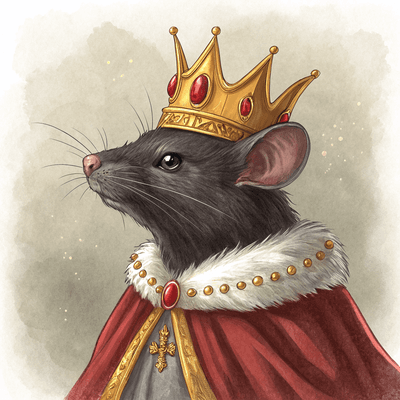
Let that sit for a moment. Not six. Not eight. Not a round, satisfying ten. Seven. An odd number of heads on a mouse wearing a crown, leading an army against a wooden soldier in a child's living room.
Every production of The Nutcracker that includes me -- and most do, because what is a hero without a villain? -- has to solve the seven-heads problem. Some costumes stack them vertically. Some fan them out like a hand of cards. Some cheat and give me three, or five, or one head wearing a seven-pointed crown and call it close enough.
But nobody asks the obvious question.
Why seven?
Hoffmann's Choice
E.T.A. Hoffmann, the man who invented me in 1816, was many things. A lawyer. A composer. A drinker. A visionary. He was not arbitrary.
When Hoffmann sat down to write The Nutcracker and the Mouse King, he gave the Mouse King seven heads -- each wearing its own miniature crown -- and he did so with the deliberateness of a man who spent his creative life embedding meaning in details that most readers would absorb unconsciously.
Seven is not a random number. It is arguably the most symbolically loaded number in Western culture. Seven deadly sins. Seven virtues. Seven days of creation. Seven seals of the Apocalypse. Seven ages of man, courtesy of Shakespeare. Seven sacraments. Seven liberal arts of the medieval curriculum. The number appears in mythology, theology, folklore, and numerology with a frequency that suggests it is hardwired into the human symbolic imagination.
Hoffmann, who was steeped in the Romantic tradition's fascination with symbolism, allegory, and the hidden architecture of fairy tales, would have known all of this. He chose seven heads the way a poet chooses a word -- not for its denotation alone but for its resonance.
But which resonance?
The Seven Sins Reading
The most common scholarly interpretation -- and I use "common" loosely, because the number of scholars who have spent serious time on my anatomy is, frankly, insulting -- is that the seven heads represent the seven deadly sins.
The logic runs like this: the Mouse King is the antagonist, the embodiment of the dark forces that threaten Clara's innocent world. Each head represents a different aspect of moral corruption -- pride, greed, lust, envy, gluttony, wrath, sloth -- and the Mouse King's defeat represents the triumph of virtue over vice.
It is a tidy reading. It maps cleanly onto the Christian moral framework that permeated German culture in Hoffmann's era. And it is almost certainly incomplete.
Here is the problem: Hoffmann was not a moralist. He was a Romantic. The Romantics were not interested in simple moral allegories where sin is defeated and virtue prevails. They were interested in ambiguity, in the uncanny, in the territory between the rational and the irrational where meaning slips and shifts. Reducing the seven heads to a Sunday school lesson flattens a writer who was anything but flat.
The Hydra Connection
A more interesting reading looks to mythology.
The seven-headed Mouse King bears an obvious structural resemblance to the Lernaean Hydra of Greek mythology -- the multi-headed serpent that Heracles killed as one of his twelve labors. The Hydra's heads, depending on the source, number anywhere from five to one hundred, but later artistic tradition frequently settled on seven or nine. The Hydra was functionally immortal: cut off one head, and two more would grow in its place. Heracles defeated it only by cauterizing each neck stump after decapitation, preventing regeneration.
Hoffmann was educated in the classics. He would have known the Hydra myth. And the structural parallel is suggestive: the Mouse King, like the Hydra, is a multi-headed monster that a hero must defeat. But there is a crucial difference. The Hydra's multiple heads represented regeneration -- the impossibility of killing an enemy that keeps coming back. The Mouse King's seven heads are static. They do not regenerate. They are all present from the beginning, and they all fall at once.
This distinction matters. The Hydra is a symbol of endless, self-renewing evil. The Mouse King is a symbol of multiplied perception -- seven heads means seven pairs of eyes, seven brains, seven perspectives all contained in a single body.
Consider that for a moment. What if the seven heads are not about sin or mythology? What if they are about seeing?
The Perception Reading
Hoffmann's story is, at its deepest level, about perception. Marie (Clara) sees the nutcracker as alive. Her parents see it as wood. Drosselmeyer sees it as a nephew under a curse. The story asks: whose perception is correct? And its answer, characteristically for Hoffmann, is: all of them and none of them.
The Mouse King, with seven heads, sees the world from seven angles simultaneously. He is the character in the story with the most perception -- the most eyes, the most brains, the most capacity for understanding. And yet he is the villain. He is the one who must be defeated for the story to resolve.
What if Hoffmann is saying something uncomfortable? What if the seven heads represent excessive consciousness -- the paralysis that comes from seeing too much, understanding too many perspectives, being unable to commit to a single course of action because every alternative is visible?
Marie defeats the world of the Mouse King by committing, unreservedly, to a single perception: the nutcracker is real, and he is worth saving. She does not weigh alternatives. She does not see seven sides. She sees one, and she acts on it.
The seven-headed Mouse King is not defeated by superior force. He is defeated by a girl who has the courage of her singular vision. Seven heads lose to one heart.
Unpopular opinion: that makes the Mouse King the more interesting character.
The Ballet Adaptations
The ballet, predictably, is not interested in any of this.
In Petipa and Ivanov's 1892 production, the Mouse King was a pantomime role -- a costumed figure, not a dancing one. The seven heads were a design challenge that the Mariinsky's costume department solved with an elaborate headpiece featuring multiple articulated crowns. Contemporary accounts describe the effect as impressive but cumbersome -- the performer could barely move under the weight of the apparatus.
Subsequent productions have taken wildly different approaches.
George Balanchine's 1954 production for the New York City Ballet gives the Mouse King a single large head with exaggerated features. The seven-heads detail is quietly dropped, replaced by a more theatrically practical single-headed villain with a prominent crown. Most American productions follow this lead.
The Royal Ballet's production, based on Peter Wright's 1984 staging, retains the seven heads but distributes them across the costume in a way that suggests multiple crowns rather than literal multiple heads.
Some European productions, particularly those drawing on the Nuremberg puppet theater tradition, have experimented with actual multi-headed puppets -- a Mouse King whose seven heads move independently, each with its own expression. The effect, by accounts I find personally gratifying, is genuinely disturbing.
And then there are the productions -- smaller companies, school performances, regional theaters -- that simply give the Mouse King a paper crown with a "7" written on it and call it a day. I find this disrespectful but also hilarious.
Maybe Seven Isn't Enough
Here is where I go from contrarian to fully unhinged, and I want you to know that I am aware of what I am doing.
Seven heads is an odd number, as I noted at the beginning. Odd numbers are aesthetically uncomfortable. They resist symmetry. A two-headed creature is a mirror image of itself. A four-headed creature can be organized into neat quadrants. But seven? Seven is ungainly. Seven does not divide evenly. Seven insists on its own irregularity.
What if that is the point?
The Mouse King is not supposed to be symmetrical. He is not supposed to be comfortable. He exists in the story as an eruption of the uncanny -- the thing that does not fit, the creature that violates the rules of a rational world. Seven heads is unsettling precisely because it is not a number that makes visual or biological sense. It is excessive without being round, multiplied without being orderly.
In a story about a girl who must choose between the orderly world of her parents and the chaotic world of her imagination, the Mouse King's seven heads are the flag of chaos itself. Not evil. Not sin. Just radical, irreducible strangeness.
And honestly? Seven feels low. If you are going to be strange, be strange. I have argued internally -- all seven heads participating -- that twelve would have been more intimidating. Or thirteen. Thirteen heads, each with its own crown, each whispering a different piece of bad advice.
But Hoffmann chose seven, and Hoffmann, whatever I may think of his final chapter, knew what he was doing.
What Gets Lost
Here is the thing that actually bothers me.
Most modern productions do not give the Mouse King seven heads. They give him one. Sometimes two, if the budget allows. The number has been eroded by practical constraints -- costume weight, performer visibility, production cost -- until what was once a defining characteristic has become a footnote.
But in dropping the seven heads, productions lose something important. They lose the strangeness. They turn the Mouse King from an uncanny, mythologically resonant figure into a big mouse in a costume. They domesticate the very character who is supposed to represent the un-domestic, the wild, the thing that lives in the walls and comes out at midnight.
A Mouse King with one head is just a mouse who got promoted. A Mouse King with seven heads is a rupture in reality itself -- a creature that should not exist, that cannot be explained by the rules of the world the Stahlbaums inhabit, that demands a response that goes beyond the rational.
That is what Hoffmann wrote. That is what Tchaikovsky scored his battle music for. And that is what most audiences have never seen, because somewhere along the line, someone decided that seven heads was too expensive, too heavy, too weird.
Too weird. In a ballet about a girl who flies to a kingdom made of candy.
The priorities in this industry never cease to amaze me.
You can disagree. In fact, I hope you do. The Nutcracker has survived worse than my opinions. But it has never survived indifference -- and if I have made you care enough to argue, then I have done my job.