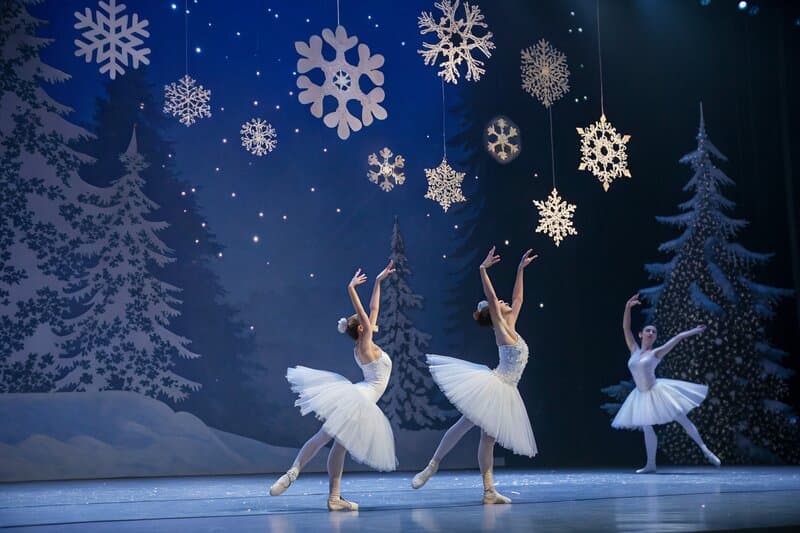
The audience arrives at seven. The dancers have been in the theater since noon.
This is the first thing outsiders do not understand about opening night: by the time you take your seat, adjust your program, and settle into the hush before the overture, the people on the other side of that curtain have already lived through an entire day of preparation so specific, so ritualized, that it resembles a ceremony more than a warm-up.
I have performed opening nights of The Nutcracker for years. The ballet changes -- choreography is restaged, casts rotate, theaters differ. But the rituals do not change. They are as fixed as the score itself, passed from generation to generation with the same reverence that dancers give to the steps.
Let me take you backstage.
The Morning: Class
Every opening night begins the same way: with company class. This is non-negotiable. It does not matter that the dancers have been rehearsing for weeks. It does not matter that they could perform their roles in their sleep. Class happens.
Company class on performance day is not about learning. It is about calibration. The body wakes up differently each morning -- stiffer here, looser there, the left hip not quite tracking the way it did yesterday. Class gives the dancer ninety minutes to take inventory, to identify what needs attention, and to bring the instrument into alignment before the demands of performance begin.
The barre work is standard: plies, tendus, degages, rond de jambes, fondus, frappes, developpes, grand battements. The sequence has not changed in its essentials since the Paris Opera codified it in the 19th century. A dancer who trained in Moscow does the same barre as a dancer who trained in New York. The vocabulary is universal. What varies is the quality of attention.
On opening day, the attention is different. Sharper. More inward. The barre becomes meditative. Dancers who normally chat between combinations are quiet. The pianist plays with a restraint that matches the room. The ballet master or mistress gives fewer corrections than usual -- not because the dancing is flawless, but because today is not about fixing problems. Today is about reminding the body of what it already knows.
Center work follows. Adagio. Pirouettes. Allegro. Jumps. The progression builds from slow to fast, from controlled to explosive, and by the end of class the dancers are warm, alert, and breathing hard. They have not yet touched their costumes. They have not yet walked the stage. But the body is awake and accounted for.
The Afternoon: Spacing and the Stage
After class, there is usually a spacing rehearsal -- a run-through on the actual stage, in the actual theater, to adjust choreography to the specific dimensions of the performance space. Stages vary more than audiences realize. A formation that reads clearly on the rehearsal studio's floor may disappear on a wider stage. An entrance that works when the wings are close may feel like a marathon when they are twenty feet further away.
Spacing rehearsal is technical, practical, unglamorous. It is about sightlines -- making sure the corps de ballet can be seen from the upper balcony, making sure the soloists do not vanish behind a flat. It is about floor texture -- some stages are raked (angled toward the audience), which changes the dancer's balance on every step. Some stages are sprung differently than the studio floor, which affects jumps and landings. A dancer who rehearsed her variation on a forgiving sprung floor may find that the stage is harder, less responsive, and adjust the height of her jumps accordingly.
This is the point in the day when the theater begins to feel real. The rehearsal studio is a place of work. The stage is a place of performance, and the shift in context changes something in the body. The same steps feel different under stage lights, in front of empty seats that will soon be full. The acoustics are different. The spatial awareness recalibrates. Some dancers find the stage liberating -- more space, more air, more room to move. Others find it exposing. Both responses are correct.
The Quiet Hours
Between the spacing rehearsal and the evening performance, there is a gap. Usually two to three hours. This is the period that defines each dancer's personal ritual, and it is the most private part of the day.
Some dancers nap. Not in beds -- there are no beds backstage -- but on yoga mats in dressing rooms, on piles of costume bags in the wings, curled in corners with sweaters over their faces. The nap is strategic. The body needs rest, but not too much -- fall too deeply asleep and the muscles cool, the joints stiffen, and the dancer must warm up again. Twenty to thirty minutes is ideal. Some dancers set alarms. Some have an internal clock so precise that they wake within a minute of their intended time.
Some dancers eat. The pre-performance meal is its own form of ritual. The Nutcracker is a physically demanding ballet -- two acts, approximately ninety minutes of dancing, with the Sugar Plum Fairy's variation, the Pas de Deux, and the Coda concentrated in the second act. The body needs fuel, but nothing heavy, nothing that will sit in the stomach during a series of lifts. I have known dancers who eat the same meal before every performance: half a banana with almond butter, or a small bowl of rice with a drizzle of soy sauce, or two hard-boiled eggs and a piece of toast. The specifics vary. The consistency does not.
Some dancers do nothing. They sit. They stare. They listen to music through headphones -- often not Tchaikovsky, which would be redundant, but something that shifts their emotional state into the register the role requires. I once shared a dressing room with a dancer who listened to Debussy before every Nutcracker performance. When I asked her why, she said, "Because Sugar Plum lives in the same key as Debussy. Crystalline." It was not a musicological statement. It was a felt truth, and I understood it completely.
The Hour Before
One hour before curtain, the dressing room comes alive.
This is where the transformation begins in earnest. Dancers arrive at their stations -- mirrors surrounded by lights, countertops covered with makeup, hairpins, tape, and sewing kits. The first task, always, is the feet. Pointe shoes must be prepared: ribbons and elastics checked, the box softened or hardened according to the dancer's preference, the platform scuffed with a cheese grater or scored with a knife to prevent slipping.
Some dancers sew their shoes on performance day. Not new shoes -- shoes that were broken in days earlier, carefully molded to the foot and then set aside for this specific performance. The sewing is the final commitment. Once the ribbons are attached, the shoe belongs to this evening.
Then makeup. Stage makeup is not cosmetic. It is architectural. The face must be visible from the back of the house -- sixty, eighty, a hundred feet away. Features that are perfectly clear at arm's length disappear under stage lights at distance. The solution is exaggeration: darker eyeliner, stronger contouring, lip color that reads across a theater. The Sugar Plum Fairy's makeup typically emphasizes the eyes -- large, luminous, slightly otherworldly. The effect up close is theatrical to the point of excess. From the twentieth row, it is precisely right.
Hair is pinned. Headpieces are secured. Costumes are checked -- every hook, every snap, every seam. The wardrobe staff performs a final inspection, and woe to the dancer who has not reported a loose clasp or a fraying elastic before this moment. There is no time for repairs once the overture begins.
The Superstitions
Ballet is an art form built on discipline, precision, and rigorous technique. It is also, in practice, one of the most superstitious professional cultures on earth.
The most universal taboo: never wish a dancer "good luck" before a performance. The approved phrase in English is "break a leg." In French, the ballet world says "merde" -- the origin of which is debated, but the tradition is absolute. In Russian companies, the phrase is "ni pukha ni pera" -- literally, "neither down nor feather," to which the dancer must reply "k chortu" -- "to the devil."
Some dancers have personal rituals that they will not discuss and cannot be persuaded to skip. A particular order in which they put on their costume. A specific wing from which they must enter for their first appearance. A word or phrase spoken to themselves in the mirror. A gesture -- touching the stage floor before the first step, crossing themselves, pressing a thumb to the rosin box.
I know a principal dancer who, before every opening night, stands alone on the darkened stage after spacing rehearsal and walks her entire choreography in silence -- no music, no costume, just the steps, performed at walking speed in the empty theater. When I asked her what she was doing, she said, "I am introducing myself to the stage." She was not joking.
These rituals are not irrationality. They are the body's way of managing the extraordinary psychological pressure of live performance. A ballet dancer has no second take, no safety net, no edit button. What happens on stage happens once, in real time, in front of an audience. The rituals create a framework of familiarity within which the unpredictable can be endured.
The Five-Minute Call
"Five minutes, please."
The stage manager's voice over the backstage intercom is the last checkpoint. Five minutes until the house lights dim. Five minutes until the overture begins. Five minutes until the curtain rises on a performance that has been prepared for weeks and will be over in ninety minutes.
The wings fill. Dancers in Act I costumes take their places -- the Stahlbaum family, the party guests, the children. They are no longer warming up or preparing. They are waiting. The quality of the silence backstage in these final minutes is unlike any other silence I know. It is not empty. It is pressurized. The air feels dense with intention.
Through the curtain, the murmur of the audience is audible -- a low, collective hum that rises and falls like a tide. Someone laughs. A child asks a question. Programs rustle. And then the house lights begin to dim, and the murmur subsides, and the silence on both sides of the curtain becomes the same silence.
The conductor raises the baton.
There is a breath -- a single, shared intake of air that travels from the orchestra pit to the wings to the audience -- and in that breath, everything that has happened since noon falls away. The class, the spacing, the nap, the banana, the makeup, the ribbons, the superstitions, the five-minute call. All of it was preparation for this: the moment when the baton comes down and the first notes of the overture fill the theater and the curtain begins to rise.
What the audience sees, from that moment forward, is a performance. What the dancers know, from that moment forward, is that everything they did today -- every plié at the barre, every pin in their hair, every whispered word in the mirror -- was an act of faith that this moment would arrive and that they would be ready for it.
They are ready.
The curtain rises.
The performance ends. The lights rise. But if you were truly watching -- truly listening -- something has changed in you. That is not entertainment. That is art.