Painting Faces: The Art of Nutcracker Expression
The Guardian · 2026-04-05
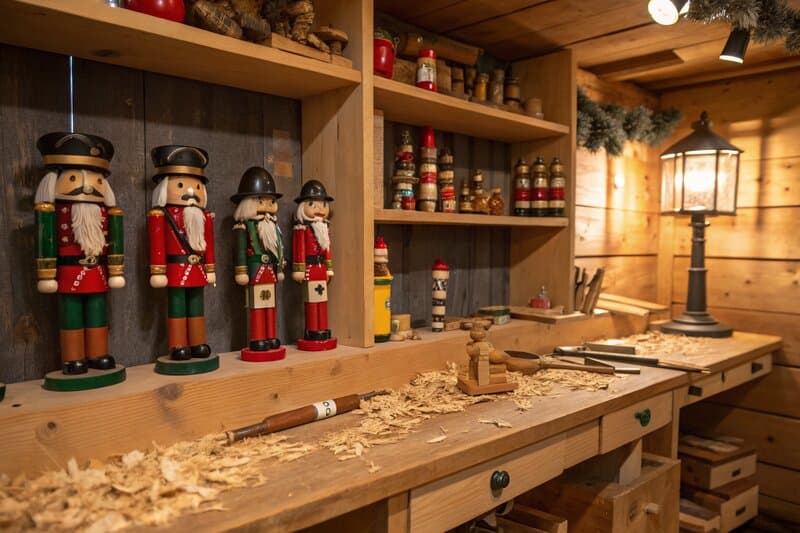
In the workshops of the Erzgebirge, there is a division of labor that has persisted for generations. The carver shapes the wood. The assembler fits the jaw. But it is the painter -- the Gesichtmaler, the face painter -- who gives the nutcracker its soul.
I use that word deliberately. A nutcracker without paint is a handsome object: pale linden wood, well proportioned, mechanically sound. But it is anonymous. It has form without character, structure without personality. It is the paint -- specifically, the face -- that transforms a carved figure into a presence. Into the thing that stares back at you from the shelf and refuses to be ignored.
The Gesichtmaler knows this. The Gesichtmaler has always known this. In the hierarchy of the traditional Erzgebirge workshop, the face painter holds a position of quiet authority that has nothing to do with seniority and everything to do with the fact that a single misplaced brushstroke can ruin twelve hours of carving.
The Palette
The traditional nutcracker palette is limited by intention, not by poverty. A Gesichtmaler works with fewer than a dozen colors for the face: a flesh tone (mixed from white, yellow ochre, and a touch of red), white for the eyes, black or dark brown for the pupils and eyebrows, red for the mouth and cheeks, and sometimes a pale blue or gray for the iris.
This economy is not a constraint. It is a discipline. With six colors and a few brushes, the Gesichtmaler must create an expression that reads from across a room. The face is small -- typically five to seven centimeters from crown to chin -- and the features must communicate clearly at a distance. There is no room for subtlety in the painterly sense. Every mark must be deliberate, legible, and correct on the first application.
The paint itself has evolved over the centuries. Early Erzgebirge nutcrackers were painted with milk-based paints -- casein mixed with pigment, which dried to a flat, chalky finish. By the 19th century, oil-based enamels became common, offering greater durability and more vivid color. Today, most workshops use acrylic paints formulated for wood, which combine the flat finish of traditional paints with modern adhesion and lightfastness. Some workshops -- particularly those that emphasize historical authenticity -- continue to use milk paint or egg tempera for the faces of their finest pieces.
Regardless of the medium, the paint is applied thin. Multiple thin coats, each allowed to dry before the next, produce a surface that is opaque but not heavy -- the wood's texture remains faintly visible beneath the paint, giving the face a warmth that thick, plastic-like coatings destroy.
The Eyes
The eyes are painted first, and they are everything.
A nutcracker's eyes are its most distinctive feature. They are disproportionately large -- occupying roughly a third of the face's width -- and perfectly round. This is not an attempt at anatomical accuracy. It is a stylistic convention rooted in folk art's understanding that expression at small scale requires exaggeration. A realistically proportioned eye on a six-centimeter face would be a dot. A folk-art eye is a circle, and a circle can stare.
The process begins with a white base coat applied to each eye socket -- the shallow depressions left by the carver's gouge. The white must be even and clean, because it will serve as the visible sclera of the finished eye. Any irregularity -- a thin spot, a stray mark -- will be visible in the final piece.
Once dry, the iris is painted. In traditional designs, the iris is a solid disc of color: blue is the most common, followed by brown and, less frequently, green or gray. The disc is centered within the white circle, and its placement is the first critical decision of the face. Eyes that are perfectly centered give the figure a direct, confrontational stare. Eyes shifted slightly upward suggest alertness or surprise. Eyes shifted downward suggest gravity or thought. The difference is measured in fractions of a millimeter, and the Gesichtmaler makes the choice by instinct, reading the carving to determine what expression the wood suggests.
The pupil follows: a smaller disc of black at the center of the iris. Then the highlight -- a single white dot, placed at the upper left or upper right of the pupil, that gives the eye its apparent depth. Without the highlight, the eye is flat, dead, painted. With the highlight, the eye appears to catch light. It appears to see.
This single white dot is, in terms of its effect-to-effort ratio, the most powerful brushstroke in the entire process. It takes a fraction of a second to apply. It transforms a painted circle into an eye that seems to follow you across the room.
The Eyebrows
If the eyes determine whether a nutcracker looks alive, the eyebrows determine what it is thinking.
The eyebrows of a traditional nutcracker are painted as simple arched lines above the eyes -- two brushstrokes, each applied in a single motion from the inner corner to the outer edge. The angle, thickness, and curvature of these lines constitute the most consequential artistic decision in the Gesichtmaler's work.
Consider the variations. Eyebrows angled sharply downward toward the nose create an expression of anger or ferocity -- the nutcracker appears to glare. Eyebrows arched high above the eyes create surprise or naivety -- the figure looks startled, even foolish. Eyebrows set level and straight suggest calm authority -- the look of a figure that has seen everything and is not impressed.
The traditional Konigstein -- the king design -- calls for eyebrows that are slightly arched, moderately thick, and set at an angle that conveys composed sternness. Not angry. Not surprised. Resolved. The king has made his decision. His eyebrows confirm it.
The Hussar nutcracker, by contrast, often receives more dramatically angled brows -- steeper, thinner, more aggressive. The soldier is meant to look fierce. The Gendarme -- the policeman -- gets eyebrows that are level and heavy, suggesting bureaucratic immovability. The Harlequin, when the design is used, may receive asymmetric brows -- one raised, one level -- conveying mischief.
These are conventions, not rules. Every Gesichtmaler interprets them through her own hand, her own sense of what the figure requires. But the conventions exist because they work. Centuries of accumulated observation have established which arrangements of line produce which emotional readings. The Gesichtmaler inherits this knowledge and, over the course of her career, makes it her own.
The Mouth
The nutcracker's mouth is unique among painted faces because it is also a mechanical feature. The jaw opens and closes, and the painted mouth must accommodate this function without looking broken or incomplete in either position.
The upper lip is painted on the fixed upper jaw: a red or dark red line, often with a slight upward curve at the corners that gives the figure the faintest suggestion of a smile -- or, in sterner designs, a perfectly level line that suggests no emotion at all. The lower lip is painted on the movable jaw piece, and the two must align when the mouth is closed to create a continuous, readable mouth.
This alignment is harder than it appears. The jaw mechanism introduces a variable: the exact position at which the jaw rests in its closed state depends on the tension of the lever spring and the precision of the pivot point. A jaw that closes a millimeter short of perfect alignment will produce a mouth with a visible gap -- the upper and lower lips will not meet, and the figure will appear to be speaking or, worse, broken.
The Gesichtmaler compensates by painting the lips slightly larger than the gap, so that even if the alignment is imperfect, the overall impression of a closed mouth is preserved. This is not a trick. It is craft knowledge -- the kind of practical intelligence that accumulates over thousands of repetitions and is passed from painter to painter through demonstration rather than instruction.
The cheeks receive a touch of red -- applied with a nearly dry brush in a circular motion, producing a soft, diffused blush rather than a hard-edged circle. The cheek color warms the face and provides a visual counterweight to the severity of the eyes and eyebrows. Without it, the nutcracker looks austere. With it, the nutcracker looks stern but alive -- a figure with blood beneath the paint.
The Difference a Hand Makes
I have examined nutcracker faces produced by mechanical means -- screen printing, decal application, automated brush systems. The features are precise. The symmetry is perfect. The colors are consistent from figure to figure. And the faces are, without exception, empty.
The emptiness is difficult to define but impossible to miss. A printed face has no weight. The lines do not carry the pressure of a hand pushing a brush through paint. The variations that give a hand-painted face its character -- the slight thickening of an eyebrow where the brush slowed, the barely perceptible wobble in an eye's outline, the way one cheek is fractionally rosier than the other -- are absent. What remains is accurate and dead.
The hand-painted face is inaccurate and alive. Its power comes not from perfection but from presence -- the visible evidence that a specific person, with a specific hand, at a specific moment, decided that this nutcracker would have this expression. The decision is embedded in the paint. The viewer responds to it without knowing why. The figure feels intentional. It feels seen. It feels as though someone cared about its particular face.
This is what the Gesichtmaler provides, and it is what no machine can replicate. Not the precision of the brushwork -- machines are more precise. Not the consistency of the color -- machines are more consistent. What the machine cannot provide is the decision. The moment when a painter looks at a carved face, reads its grain and its gouge marks and its proportions, and decides: this one is a king. This one is stern. This one is noble. This one stares at you like it knows something you do not.
The Final Inspection
When the face is complete, the Gesichtmaler holds the figure at arm's length and examines it. Not with the close scrutiny of the painting process, but with the distance of the eventual owner. At arm's length, the small imperfections disappear. What remains is the expression -- the overall impression created by the arrangement of eyes, brows, mouth, and color.
If the expression is right -- if the Konigstein looks like a king, if the Hussar looks like a soldier, if the figure conveys the character that the carver intended and the painter interpreted -- the Gesichtmaler sets it aside and picks up the next blank face.
If the expression is wrong -- if the angle of a brow has tipped the king into comedy, or the placement of an eye has made the soldier look startled -- there are limited options. Acrylic paint can be removed from linden wood with care, but repainting over a corrected face rarely achieves the freshness of a first application. More often, the figure is set aside for secondary sale or, in workshops with exacting standards, discarded. The wood can be reclaimed. The labor cannot.
This quality of judgment -- the ability to see, at arm's length, whether a face works -- is the Gesichtmaler's highest skill. It cannot be taught by instruction. It is taught by repetition, by painting hundreds and then thousands of faces, by developing the eye's ability to read expression the way a musician's ear reads pitch: instantly, reflexively, and without conscious analysis.
What Remains
I think about the Gesichtmaler sometimes when I look at the faces of the nutcrackers in my care. Each face was painted by someone. Each expression was a decision. The eyes that stare from the shelf were given their stare by a person who held a brush and decided what this particular nutcracker should see.
It is a small thing, in the scheme of things. A few brushstrokes on a piece of wood. But the result is a figure that has a presence -- a personality that outlasts the painter, the workshop, and the season in which it was made. A hundred years from now, the Konigstein on your shelf will still be staring forward with the expression its Gesichtmaler chose. It will still look like it knows something.
A nutcracker carved by hand carries something a factory cannot replicate. Not just the marks of the chisel, but the patience of the person who held it. That is worth protecting.