I need to tell you about the time I watched two people fall in love in three minutes and forty seconds.
They were not in love. I know that. They were dancers -- professionals, performing the grand pas de deux from Act II of The Nutcracker, the duet between the Sugar Plum Fairy and her Cavalier. I had seen this dance before, many times, in many theaters. I knew the structure: the adagio, where the two dancers move together in sustained, flowing partnership; the individual variations, where each dances alone; and the coda, where they reunite for the finale.
I knew what was coming. And it did not matter. Because something was happening between these two dancers that I had not seen before, and I still do not entirely have the language for it.
It was chemistry. But that word is too small.
What a Pas de Deux Actually Is
The term is French. It means "step of two." In classical ballet, a pas de deux is a duet -- specifically, a structured duet with a defined form. The grand pas de deux, the most formal version, follows a five-part structure: the entree (entrance together), the adagio (slow, sustained partnering), two solo variations (one for each dancer), and the coda (the shared finale).
This structure was codified in the 19th century by choreographers like Marius Petipa, who shaped the Imperial Russian Ballet and, with it, the language of classical dance. Petipa choreographed the original Nutcracker scenario in 1892, though Lev Ivanov completed much of the actual choreography after Petipa fell ill.
The Sugar Plum Fairy's grand pas de deux is one of the most performed partnering sequences in ballet. Tchaikovsky scored it with a sweeping, romantic melody that builds from a gentle opening to a full orchestral climax -- the kind of music that makes the air in a theater feel thicker, warmer, as though the room itself is leaning toward the stage.
But the structure and the music are only the frame. What goes inside the frame -- what makes one performance of this duet forgettable and another one devastating -- is the relationship between two bodies.
The Mechanics of Trust
Here is something I did not understand until I started paying close attention: the pas de deux is, physically, an act of absolute trust.
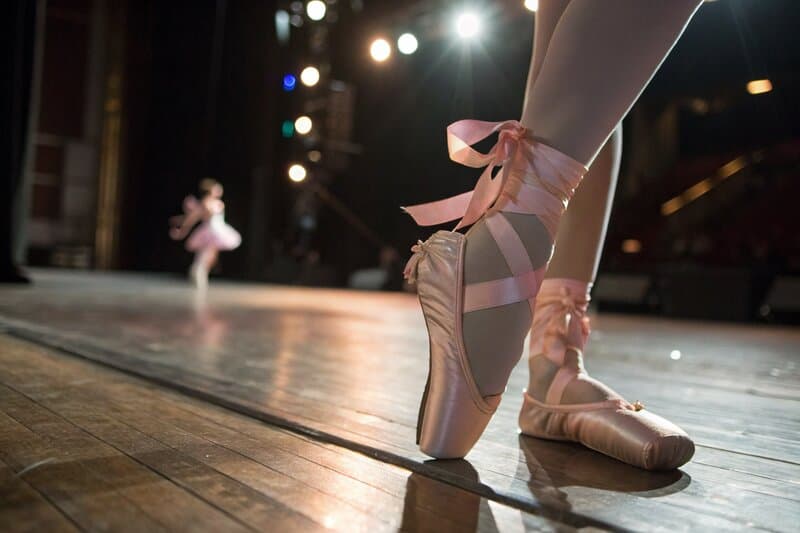
The ballerina executes movements -- turns, lifts, balances -- that are literally impossible without her partner's support. During a promenade, the ballerina stands en pointe on one foot while the Cavalier slowly turns her by the hand. Her balance depends entirely on the pressure of his fingers. Too much, and the turn is forced. Too little, and she falls. The correct pressure is a conversation that happens in real time, through skin.
In lifts, the physics are even more demanding. The Cavalier lifts the ballerina overhead, sometimes with one hand, while she maintains a pose that requires every muscle in her body to be engaged. She must trust that he will hold her. He must trust that she will maintain her position. If either one fails -- if she shifts her weight unexpectedly, if he misjudges the trajectory -- the result is not a missed step. It is an injury.
This is what the audience does not see, or sees without understanding. The seamlessness of a great pas de deux is not the absence of difficulty. It is the evidence of difficulty so thoroughly conquered that it has become invisible. What looks like effortless floating is actually two people negotiating physics, timing, and balance in real time, communicating through touch, breath, and the micro-adjustments of muscle that only years of training make possible.
Sugar Plum Fairy would explain this better than I can -- she has lived inside these mechanics, and she understands them the way a pilot understands aerodynamics. I understand them the way a passenger understands flight: I know it works, I can see that it works, and the fact that it works at all seems miraculous to me.
The Night That Changed How I Watch
It was a December matinee. I will not name the company, because what I want to describe is not about reputation or pedigree. It is about a moment.
The adagio began. The Sugar Plum Fairy and the Cavalier entered from opposite wings. This is standard. What was not standard was the way they looked at each other.
In most performances I have seen, the dancers maintain what I think of as "ballet face" -- a serene, pleasant expression that communicates beauty and composure but not specific emotion. It is the default. It is professional. It is, if I am being honest, slightly blank.
These two were not blank. When the Cavalier took the Sugar Plum Fairy's hand for the first time, he looked at her the way you look at someone you have been waiting for. And she looked back -- not coy, not performative, but present. As though she had just arrived in a room she had been thinking about all day.
It changed the entire dance. Every supported turn became a conversation. Every lift became an offering. When he promenaded her in arabesque, his free hand hovering near her waist without quite touching -- that sliver of air between his palm and her body -- I felt my breath catch.
I do not know if they were friends. I do not know if they had danced together a hundred times or if this was their first partnering. I do not know what private understanding existed between them, what shared rehearsal hours, what adjustments whispered in the wings. I only know what I saw from my seat in the mezzanine, and what I saw was two people who had figured out how to listen to each other through movement.
The adagio lasted perhaps four minutes. I cried. Not dramatic, audible crying -- just that quiet leak of tears that happens when something beautiful catches you off guard and you do not have time to compose your response.
Why Chemistry Cannot Be Faked
I have thought about this a great deal since that afternoon, and I have arrived at something I believe is true: pas de deux chemistry cannot be manufactured. It can be rehearsed, certainly. Two skilled professionals can execute a technically flawless duet through sheer discipline and preparation. But the thing that makes an audience forget to breathe -- the thing I felt that afternoon -- comes from somewhere that choreography cannot reach.
It comes, I think, from genuine attentiveness. From two people who are not merely performing prescribed movements but actually responding to each other in real time. The micro-adjustments become micro-conversations. The hand on the waist is not just support -- it is a sentence. The tilt of the head during a promenade is not just a position -- it is a reply.
Some of the most celebrated partnerships in Nutcracker history had this quality. Mikhail Baryshnikov and Gelsey Kirkland, in the American Ballet Theatre's 1977 television production, are often cited as the gold standard. Kirkland herself wrote about the experience of dancing with Baryshnikov, describing the way his partnering made her feel "both supported and free" -- held securely enough to take risks, released generously enough to fly.
More recently, principal dancers like Tiler Peck and Tyler Angle at the New York City Ballet have demonstrated a long-developed partnership chemistry that audiences recognize instantly. It is the accumulated ease of years, the way two musicians who have played together for decades can anticipate each other's phrasing without a cue. It is not romantic love. It is something rarer: artistic trust.
The Audience's Role
There is one more thing I want to say about this, and it is something I have never read in a program note or a review. I think the audience is the third dancer in a pas de deux.
Not literally. Obviously. But the quality of attention in a theater changes what happens on stage. I have been in audiences that were restless -- coughing, shifting, checking programs -- and the performance onstage seemed to contract, to become smaller, as though the dancers were protecting themselves from the inattention. And I have been in audiences that were utterly still, leaning forward in that particular way that means every person in the room has forgotten they are in a room, and the performance seemed to expand, to breathe, to fill the space that the audience's attention created for it.
That matinee, the audience was still. Two thousand people holding their breath while two dancers held each other, and the celesta played its impossible melody overhead, and the air in the theater became the kind of thick, warm, luminous air that you only find in places where something true is happening.
I cannot prove this. I cannot measure it. Sugar Plum would tell me I am romanticizing, and the Mouse King would tell me I am projecting. They are probably both right. But I was there, and I know what I felt, and what I felt was three thousand people -- two on stage and the rest of us in the dark -- all breathing at the same time.
An Invitation
If you have not seen the grand pas de deux performed live, I want to encourage you to watch for the things I have described. Not just the lifts and turns, though those are beautiful. Watch the hands. Watch the moments between the movements -- the half-second when the Cavalier releases the ballerina and she is, for one heartbeat, entirely on her own, balanced on a single pointe shoe, trusting that he is still there.
That half-second is the whole thing. The whole dance, the whole partnership, the whole relationship between two people who have agreed to make something beautiful together. It is not about romance, though it can look like it. It is about the decision to trust someone else with the full weight of your art.
And if you are lucky -- if the afternoon is right, if the dancers are listening to each other, if the audience is still -- you might feel what I felt. That quiet, unannounced leak of tears. The recognition that you are watching something you cannot rehearse.
Chemistry. But the word is too small.