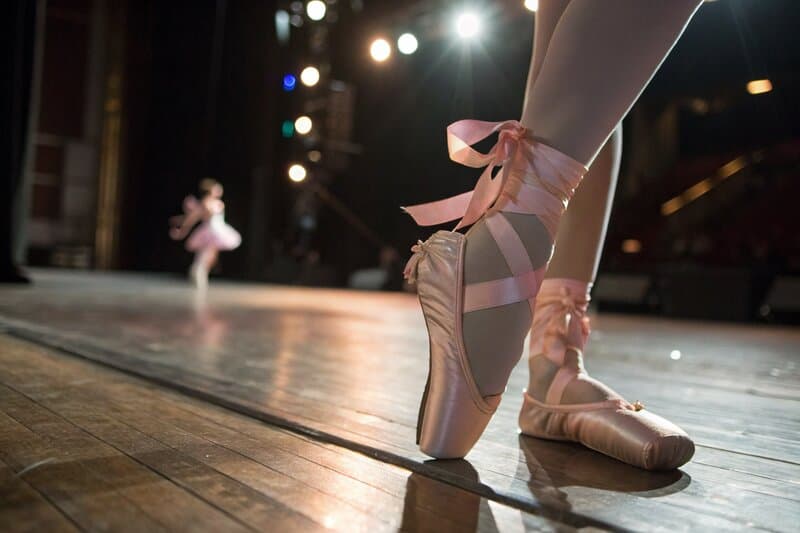
A ballerina en pointe balances her entire body weight on a platform roughly the size of a silver dollar. The area of contact with the floor is approximately twelve square centimeters. The force per unit area is, depending on the dancer's weight and the specific step, between five and ten times what a stiletto heel exerts on a hard surface.
The physics are unreasonable. The artistry is in making you forget that.
I have spent my career on the tips of my toes, and I can tell you that what the audience sees -- the effortless suspension, the shimmer of stillness at the top of a balance -- is the product of engineering as precise as any bridge or cantilever. The engineering happens in two places: in the shoe and in the body. Neither works without the other.
Let me show you both.
The Architecture of a Pointe Shoe
A pointe shoe is not a shoe in any conventional sense. It is a tool -- a highly specific piece of equipment designed to allow a human foot to do something human feet were not designed to do. Its construction has remained fundamentally unchanged since the 1880s, though the materials and manufacturing techniques have evolved considerably.
The critical component is the box -- the rigid, flat-tipped enclosure that surrounds the toes. In traditional construction, the box is made from layers of burlap, paper, and cardboard, bonded together with paste and shaped over a wooden last. The paste is typically a proprietary flour-based adhesive, though some manufacturers have introduced synthetic alternatives. When the paste dries, the layers harden into a shell that is simultaneously rigid enough to support the dancer's weight and flexible enough to allow articulation through the metatarsals.
Beneath the foot lies the shank -- a stiff insole, traditionally made from a single piece of leather or compressed cardboard, that runs from the heel to the ball of the foot. The shank is the spine of the shoe. It provides the resistance against which the dancer pushes when rising en pointe, and its stiffness determines how much muscular effort is required to maintain the position. A harder shank demands more strength but provides more support. A softer shank allows greater articulation but fatigues the foot faster.
The outer sole is leather. The satin upper is stitched to the sole with a drawstring at the opening. Ribbons and elastic are sewn on by the dancer herself -- this is not optional customization but a necessary step, because the placement of the ribbons relative to the ankle joint varies by anatomy and affects both security and circulation.
Here is a fact that surprises people outside the profession: a professional ballerina may go through two to four pairs of pointe shoes per week during performance season. A principal dancer in a major company may use three hundred pairs in a single year. The shoes are not designed to last. They are designed to perform -- and performance, at this level, is destructive.
The box softens. The shank breaks down. The paste, which gave the shoe its rigidity, absorbs moisture from the dancer's sweat and gradually returns to its original pliable state. A shoe that was perfectly supportive at the start of Act I may be dangerously soft by the end of Act II. Dancers learn to feel the moment when a shoe begins to die. It is one of the first professional instincts you develop, and one of the most important.
The Biomechanics of Rising
What happens inside the body when a dancer rises en pointe is a cascade of muscular recruitment that begins at the floor and ends at the crown of the head.
The foot itself contains twenty-six bones, thirty-three joints, and more than a hundred muscles, tendons, and ligaments. When a dancer rises onto pointe, the ankle moves into extreme plantar flexion -- the toes point straight down, and the top of the foot forms a continuous line with the shin. This position requires extraordinary flexibility in the anterior ankle joint and strength in the posterior muscles, particularly the gastrocnemius and soleus (the calf muscles) and the deep intrinsic muscles of the foot.
The metatarsophalangeal joints -- where the toes meet the foot -- bear the full compressive load. In a healthy foot with proper technique, the weight is distributed primarily across the first and second metatarsal heads. In an improperly aligned foot, the weight shifts laterally, concentrating force on the smaller, more fragile outer metatarsals. This is where injuries begin.
But the foot is only the foundation. What enables a dancer to balance en pointe is not foot strength alone but the coordinated engagement of the entire kinetic chain: the deep rotators of the hip, the muscles of the pelvic floor, the transverse abdominis, the erector spinae, even the small stabilizers of the cervical spine. A dancer who relies on her feet alone will wobble. A dancer who engages from her center will be still.
This is why pointe work is not introduced until a student has years of training in flat shoes. The Royal Academy of Dance recommends a minimum age of twelve, with at least two years of prior ballet training, before a student attempts pointe. The bones of the foot do not fully ossify until the mid-teens -- before that, the cartilaginous growth plates are vulnerable to compression injuries that can cause permanent deformity. This is not conservative overcaution. It is skeletal fact.
What the Audience Does Not See
The toll is real. I say this not for sympathy but for accuracy.
Professional ballet dancers who spend years en pointe develop feet that would alarm a podiatrist. Bunions -- bony protrusions at the base of the great toe caused by chronic lateral pressure -- are nearly universal. Stress fractures of the metatarsals are common. Blistering, toenail damage, and nerve compression are so routine that dancers rarely mention them.
The second toe is particularly vulnerable. In many dancers, the second metatarsal is longer than the first -- a foot shape called Morton's toe -- which means it absorbs disproportionate force en pointe. Over years, this can lead to stress fractures, joint degeneration, and chronic pain that continues long after retirement.
Achilles tendinopathy is another occupational reality. The repeated loading and unloading of the Achilles tendon during releves and pointe work causes microscopic damage that, in a healthy body with adequate rest, repairs itself. In the body of a professional dancer performing eight shows a week during Nutcracker season, adequate rest is a theoretical concept.
I mention these realities not to diminish the art but to illuminate it. When you watch a dancer sustain a balance en pointe -- still, suspended, seemingly weightless -- you are watching someone manage a remarkable amount of physical stress while presenting an image of absolute ease. The gap between what is happening and what appears to be happening is the measure of the artist's skill.
The Evolution of the Shoe
Pointe shoes as we know them did not appear fully formed. They evolved over roughly a century of iterative experimentation.
Marie Taglioni, who in 1832 danced the full-length La Sylphide, is generally credited with popularizing dancing en pointe, though she was not the first to attempt it. Her shoes were soft satin slippers with minimal stiffening -- she rose onto her toes through sheer strength, aided by darning the tips of her shoes to create a small, flattened platform. Contemporary illustrations show her barely perched on the tips, her line beautiful but precarious.
By the 1860s, Italian shoemakers -- particularly in Milan -- began reinforcing the toe area with stiffer materials. The box emerged. The platform widened. The shank developed. Anna Pavlova, dancing at the turn of the twentieth century, wore shoes that were recognizably modern in construction, though still softer and less supportive than what a dancer would use today.
The most significant recent development has been the introduction of synthetic materials. Companies like Gaynor Minden, founded in 1993, replaced the traditional paste-and-burlap box with elastomeric polymers that do not break down with moisture. The result is a shoe that maintains its support throughout a performance -- and, controversially, across multiple performances. Traditionalists argue that synthetic shoes alter the dancer's relationship with the floor, reducing the tactile feedback that natural materials provide. Advocates counter that a shoe that does not die mid-performance is simply better engineering.
The debate continues. I have used both. Each has virtues. What matters is not the material but the result: a dancer who can stand where no one should be able to stand, and make it look like the most natural thing in the world.
Why It Matters
I am occasionally asked -- usually by someone who means well -- whether pointe work is "worth it," given the physical cost. The question assumes that the body's comfort is the highest value and that anything which compromises it requires justification.
I understand the assumption. I reject it.
Every art form that involves the body demands something from the body. A pianist develops tension in the forearms and wrists. A singer's vocal cords are subject to nodules and strain. A violinist's left hand develops calluses that would be considered pathological in anyone who did not play the violin. We do not ask these artists whether their art is "worth it." We understand that mastery requires sacrifice and that the sacrifice is part of the bargain.
Pointe is the same. It is a technology -- part mechanical, part anatomical -- that allows the human body to achieve a line, a suspension, a quality of stillness that is available no other way. When I stand en pointe, I am two inches taller, but that is not the point. The point is that the entire visual vocabulary of the movement changes. The geometry shifts. The relationship with gravity shifts. Something that was grounded becomes aerial. Something that was human becomes -- for a moment -- something else.
That transformation is the purpose. The shoe makes it possible. The body makes it real. And the audience, if everything is working, sees neither the shoe nor the effort. They see only the result: a figure that appears to exist outside the ordinary laws of the physical world.
The physics are unreasonable. The artistry is in making you forget that.
The performance ends. The lights rise. But if you were truly watching -- truly listening -- something has changed in you. That is not entertainment. That is art.