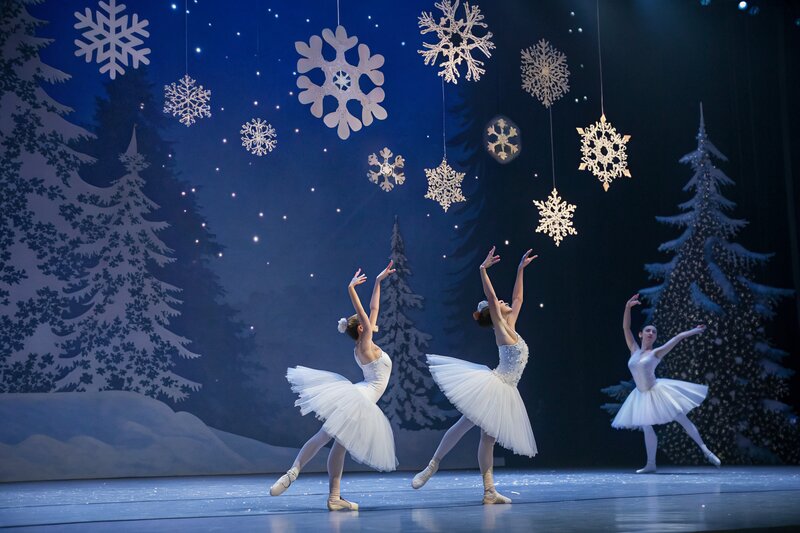
There is a corridor behind the stage -- every theater has one, though they all look different -- where the snowflake dancers wait.
The floor is cold. Ballet flats against concrete, or linoleum, or whatever surface the theater provides for the parts of itself that the audience never sees. The walls are painted a color no one chose on purpose. There are pipes overhead, and the hum of the ventilation system, and somewhere in the distance the muffled sound of Tchaikovsky -- the battle scene, the transformation -- arriving through the walls like weather from another room.
The dancers are in white. Tulle and sequins and headpieces that catch the backstage work lights and throw small points of brightness onto the ceiling. They stretch. They adjust straps. They mark steps with their hands, tiny gestures in the air -- a flick of the wrist for a port de bras, a circling motion for a chaine turn. Their faces are painted, their hair pinned, their rosin applied. Everything that can be prepared has been prepared.
What remains is the waiting.
The Body Before
Stage fright is the wrong phrase for it. Fright implies fear of something specific -- a predator, a fall, a catastrophe. What happens in the wings before the Waltz of the Snowflakes is less specific than that. It is the body's awareness that it is about to be seen. Not looked at. Seen. The way a landscape is seen -- wholly, without exception, from every angle simultaneously.
The heart rate increases. This is measurable. Studies of performing artists have documented pre-performance heart rates of 120 to 150 beats per minute -- higher than moderate exercise, comparable to the body's response to genuine physical threat. The sympathetic nervous system is preparing the body for exertion that is both athletic and emotional. The muscles receive more blood. The pupils dilate. The breath shallows.
Dancers learn to manage this. Not to eliminate it -- elimination would be undesirable, because the adrenaline is fuel. The goal is to channel the body's alarm into the body's art. A dancer who goes onstage without the elevation of nerves will give a technically correct but emotionally flat performance. A dancer who goes onstage overwhelmed by them will give a shaky one. The corridor between those two states is narrow.
In the backstage corridor, the snowflake dancers walk this corridor. Some pace. Some stand still with their eyes closed. Some talk quietly to each other -- not about the performance, about nothing, about what they had for dinner, because ordinary words are a kind of anchor. Some touch the wall, or the barre if there is one, pressing their fingers into something solid as if to confirm that the physical world is still present and will remain present when they walk into the light.
The Collective Breath
There is a moment -- and I have watched it happen enough times to know it is real, not imagined -- when the group shifts.
It does not happen all at once. It moves through the dancers the way a breeze moves through tall grass -- one body responds, then the next, then the next. The chatter fades. The stretching slows. Someone stops mid-sentence and does not finish the thought, and no one asks them to.
They can hear the music changing. The battle is ending. The transformation is underway. The tree is growing -- they know this because the backstage lighting shifts as the front-of-house lights dim for the scene change. The work lights in the corridor take on a bluish cast, reflected from the stage wash bleeding into the wings.
And then there is a silence that is not silence. It is the accumulated attention of forty-eight people whose bodies know what is about to happen before their minds fully register it. They move toward the wings. Not rushing. Not slowly. Moving the way water moves toward a drain -- inevitably, without effort, following a gradient that is felt rather than seen.
The stage manager's voice, low and flat in the headset, calls the standby. The cue light glows green. The paper snow is loaded in the cradles above. The fans are positioned. The choir, if there is a live one, is breathing in unison somewhere in the darkness.
Forty-eight dancers in white, standing at the edge of the dark, about to become something else.
The Threshold
I want to describe the threshold itself. The physical boundary between backstage and onstage. It is, in most theaters, simply a gap in the wing curtain -- a black masking flat that hides the wings from the audience's sight. You step past it, and you are visible. You step back, and you vanish.
This boundary is approximately eighteen inches wide.
On one side: concrete floor, work lights, the smell of dust and rosin and hairspray, the solidity of your own name and body and the particular way your left knee has been aching since warm-up.
On the other side: marley floor, stage light, the smell of nothing because your senses reorganize under the lights, and the dissolution of your particular self into the particular role the choreography has assigned you.
Eighteen inches.
The dancers cross it the way swimmers enter cold water. Some plunge. Some hesitate. All of them, once across, are different. The transformation is not metaphorical. It is neurological. The brain under stage light processes differently than the brain in the wings. The peripheral vision widens. The sense of spatial positioning -- proprioception -- sharpens. The consciousness of individual identity narrows, replaced by a heightened awareness of the group, the pattern, the formation.
This is not mysticism. It is what ensemble performance demands. A snowflake dancer who is thinking about herself -- her technique, her turnout, her position relative to the dancer beside her -- is operating at the wrong scale. The Waltz of the Snowflakes requires thinking at the scale of the storm. Each dancer must be aware of the whole formation and her place within it, the way a single bird in a murmuration is aware of the flock.
The neuroscience of this kind of collective awareness is still poorly understood, but the phenomenology is well documented. Dancers describe it as a state of heightened receptivity -- a loosening of the boundary between self and group that feels, from the inside, like relief. The weight of individuality lifts. You are no longer a person with a sore knee and a mortgage and an argument you had that morning. You are a particle in a pattern, and the pattern is beautiful, and being part of it is enough.
The First Note
The choir enters on a vowel sound. Not a word. A sound.
It is sustained, open, hovering above the orchestra the way mist hovers above a lake at dawn -- present but not solid, there but not graspable. The key is E-flat major. The dynamic marking is piano, softening to pianissimo. The sound does not begin so much as it appears, the way snow appears -- you cannot point to the moment it starts falling, only to the moment you notice it has begun.
Beneath the choir, the strings begin the waltz. Three-four time, the rhythm of falling -- lift, suspension, descent. Lift, suspension, descent. The melody turns in on itself, restates, fragments, rebuilds. It is circular. It does not progress the way dramatic music progresses, from tension to resolution. It accumulates, the way snow accumulates. Layer over layer. Voice over voice.
And the dancers are moving.
They enter from the wings in formations that are already in motion -- not stepping onto the stage and then beginning to dance, but arriving mid-phrase, as though the dance has been happening somewhere invisible and they are simply crossing into the audience's field of vision. This is a choreographic choice that produces a specific psychological effect: the audience feels that they are witnessing something that existed before they saw it and will continue after they look away.
The formations shift. Lines become circles. Circles become diagonals. Diagonals dissolve into scatter and reform into lines. The patterns are kaleidoscopic -- the eye cannot track any single dancer through them. The individual disappears. The phenomenon remains.
What You Become
I cannot tell you what it feels like from the outside. I can only tell you what it feels like from inside the snow.
You are warm. This is the first surprise. The lights are hot, and the exertion is real, and the tulle holds body heat close. You are warm, and the audience thinks you are cold, and this disjunction is part of the strange privacy of performance -- you and the audience are in the same room, experiencing entirely different weather.
You do not see faces. The stage lights are too bright and the auditorium is too dark. What you see is darkness punctuated by the occasional glint of an eyeglass lens or a program being opened. The audience is a presence, not a collection of individuals. A weight. A warmth of its own kind. You feel them the way you feel a fire in another room -- not directly, but through the air between.
The paper snow is falling, and it lands on your shoulders and in your hair and on your eyelashes, and you cannot brush it away because your hands are occupied with port de bras, so you dance with snow on your face and in your peripheral vision, and after a while you stop noticing it the way you stop noticing rain if you stay in it long enough.
And somewhere inside the music, inside the pattern, inside the collective breath of forty-eight bodies moving in the same three-four time, there is a moment where the stage fright -- the adrenaline, the self-consciousness, the awareness of being seen -- goes quiet. Not gone. Quiet. Moved to a room at the back of the mind where it can watch but not interfere.
What replaces it is presence. Not confidence. Not skill. Presence. The experience of being exactly where you are, doing exactly what you are doing, with nothing left over. No past, no future, no name. Just movement. Just snow. Just the sound of voices singing vowels in a key that belongs to winter.
After
The waltz ends. The music resolves. The snow stops falling.
The dancers exit, and the threshold claims them back. Eighteen inches, and you are a person again. The sore knee returns. The backstage work lights are too bright. Someone hands you a towel. There is paper snow in your costume, in your shoes, in places you will find it for days.
The applause, if it comes -- and it comes, it almost always comes, because the Waltz of the Snowflakes earns its applause the way winter earns spring -- arrives muffled through the curtain, a sound like distant weather.
You are breathing hard. You are covered in someone else's idea of snow. Your heart rate is coming down from wherever it went, and the adrenaline is metabolizing into something that feels like sadness, or gratitude, or the particular emptiness that comes after any complete expenditure of self.
In the corridor, the dancers begin to decompress. They stretch. They drink water. They pull paper snow from each other's headpieces with the tenderness of grooming animals. Someone laughs. Someone says "that was a good one." Someone says nothing at all and stands with their back against the cold wall, eyes closed, still somewhere inside the waltz.
Somewhere tonight, in a theater you have never entered, forty-eight dancers are standing in a corridor in white. The battle is ending. The tree is growing. The cue light is about to change.
They are afraid. They are ready. They are about to stop being people and become weather.
The music will begin. The snow will fall. And for six minutes, in the space between the wings and the light, something will happen that cannot be rehearsed, only entered.
It is still happening. It does not need an audience. But it rewards one.