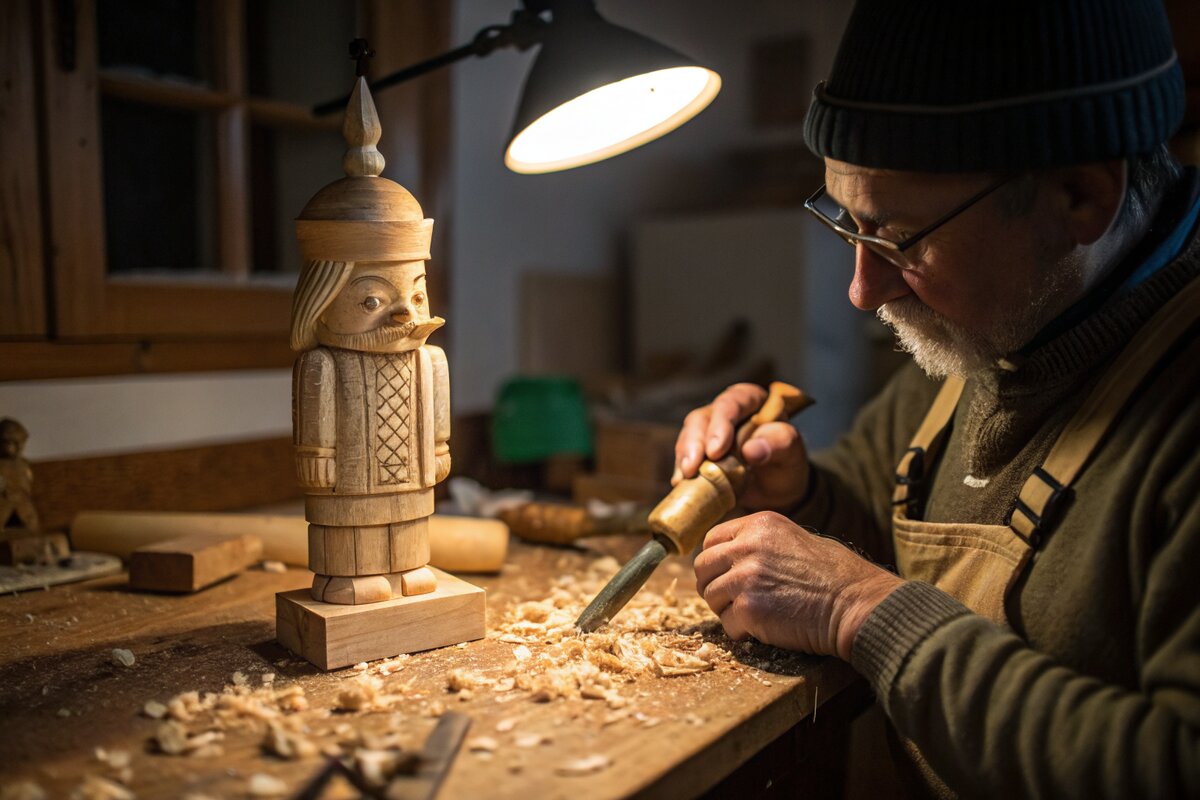
In the village of Seiffen, where the Erzgebirge mountains meet the sky, a man named Werner Fuechtner sits at the same style of workbench his forebears used in the 19th century. The tools before him -- a series of gouges, a coping saw, a small mallet, a steady hand -- have not fundamentally changed in two hundred years. The wood is linden, also called limewood, chosen for the same reasons it has always been chosen: it is soft enough to carve with precision, hard enough to hold detail, and pale enough to accept paint without distortion.
He is carving a king.
The figure will stand roughly 38 centimeters tall when finished. Its jaw will open and close on a simple lever mechanism -- the defining feature that separates a nutcracker from a mere wooden figure. Its uniform will be painted in the colors of a Prussian officer: deep blue coat, red epaulets, white trousers. Its face will carry the expression that all traditional German nutcrackers share -- stern, wide-eyed, faintly absurd, as if the figure is simultaneously a soldier and the idea of a soldier, filtered through generations of folk humor.
The process from raw linden block to finished nutcracker will take, depending on the complexity of the design, between four and twelve hours of skilled labor. There is no shortcut. The wood does not permit one.
Where the Tradition Began
The Erzgebirge -- the Ore Mountains -- straddle the border between the German state of Saxony and the Czech Republic. For centuries, these mountains were defined by mining. Silver, tin, cobalt, and iron drew workers to settlements that clung to steep valleys and forested ridges. The towns that emerged -- Seiffen, Olbernhau, Annaberg-Buchholz -- were mining communities first, and the culture that developed was shaped by what mining demands: patience, precision, working in difficult conditions with limited resources.
When the mines began to fail in the late 17th and early 18th centuries, the communities faced a familiar economic crisis: the primary industry was dying, and an alternative was needed. The forests that surrounded the mining towns provided the answer. Wood was abundant. Tools were available. And the miners, who had spent their lives performing detailed manual work in confined spaces, already possessed the foundational skill that woodcarving requires: a steady hand in service of precision.
The transition from mining to woodcraft was not instantaneous, but it was thorough. By the mid-18th century, the Erzgebirge had established itself as the center of German wooden toy and figure production. Christmas pyramids, smoking men (Raeuchermann), arched candle holders (Schwibbogen), and nutcrackers -- all emerged from this crucible of economic necessity and manual skill.
The nutcracker specifically appears in the historical record around the late 18th century, though folk tradition suggests earlier origins. The earliest known Erzgebirge nutcrackers were functional kitchen tools -- utilitarian jaw mechanisms designed to crack hazelnuts and walnuts. The decorative element -- the painted soldier, the king, the gendarme -- evolved over decades as carvers discovered that a figure with personality sold for more than a figure without one.
By the time E.T.A. Hoffmann published The Nutcracker and the Mouse King in 1816, the decorative nutcracker was already a fixture of German Christmas markets. Hoffmann almost certainly encountered them. The question of whether his story created the cultural significance of the nutcracker or merely reflected it is one that historians enjoy debating. The answer, as with most questions of cultural influence, is probably both.
The Anatomy of a Traditional Nutcracker
A traditional Erzgebirge nutcracker is not complicated. That is part of its genius.
The body is turned on a lathe -- a single cylinder of linden wood shaped into the torso and base. The head is carved separately, also from linden, and attached to the body with a wooden dowel. The jaw is the critical component: a lever mechanism, usually made from a harder wood or metal, that allows the lower jaw to open when a lever at the back of the figure is pressed.
The arms are carved separately and attached with small wooden pins. In traditional designs, they hang at the figure's sides or hold objects -- a sword, a scepter, a lantern. The base is flat and weighted to provide stability.
After assembly, the figure is primed, painted, and detailed. Traditional paint colors are bold and flat -- the Erzgebirge palette favors primary colors applied without gradient or shading, producing figures that look like folk art rather than realistic portraits. This is intentional. The nutcracker is not meant to resemble a person. It is meant to evoke one -- to capture the essence of a king or a soldier or a guardsman through color and posture rather than anatomical accuracy.
The final step is the hair and beard, which in traditional nutcrackers are made from rabbit fur or, increasingly, synthetic alternatives. The fur is glued in place and trimmed to shape. A well-made beard transforms the figure, softening the carved severity of the face and giving the nutcracker its characteristic look of grumpy dignity.
The entire process -- from lathe to finished figure -- involves at least a dozen discrete steps, each performed by hand. In the workshops of Seiffen and its neighboring villages, these steps are still sometimes divided among family members, with one person turning, another carving, another painting. The division of labor is a holdover from the 18th-century production model, when families functioned as small factories, each member responsible for a specific stage of the craft.
The Fuechtner Legacy
No discussion of Erzgebirge nutcrackers is complete without the Fuechtner family, who have been carving nutcrackers in Seiffen since the early 19th century. Wilhelm Friedrich Fuechtner, born in 1844, is widely credited with creating the first commercially produced decorative nutcracker in the style we recognize today -- the standardized soldier figure with movable jaw, painted uniform, and rabbit-fur beard.
Whether Fuechtner truly "invented" the decorative nutcracker or merely codified and commercialized an existing folk form is debated. What is not debated is the family's influence. The Fuechtner workshop established the template that thousands of subsequent nutcracker producers have followed. The proportions, the color palette, the relationship between figure and base, the expression on the face -- these conventions trace back to the Fuechtner tradition.
The family workshop still operates today, though the landscape around it has changed dramatically. The 20th century was not kind to the Erzgebirge craft tradition. Two world wars disrupted production. The region's incorporation into East Germany after 1945 brought state control over the workshops, which were organized into production cooperatives. Some carvers welcomed the stability; others chafed under quotas and standardization that they felt eroded the individual character of their work.
Reunification in 1990 brought new challenges: exposure to global competition, the influx of cheap mass-produced nutcrackers from China, and the departure of young people from the mountain villages for opportunities in larger cities. The workshops that survived did so by emphasizing what mass production cannot replicate: the irregularity, the warmth, and the unmistakable presence of a human hand in every figure.
What the Hand Leaves Behind
I have spent time in these workshops. I have watched a carver named Matthias take a cylinder of linden and, with a series of gouge cuts that look casual but are the product of decades of muscle memory, produce a face. Not a generic face. A specific face -- a king with a particular set of the jaw, a particular angle of the brow, a particular expression that no other king in the batch will share.
This is what machines cannot do. A CNC router can produce a nutcracker of perfect consistency. Every face will be identical. Every cut will be precise to the micron. And every figure will be, in a way that is difficult to articulate but impossible to miss, dead.
The hand-carved figure is alive. Not literally -- I am a prince, not a mystic -- but in the sense that it carries evidence of its making. A slight asymmetry in the eyes. A gouge mark on the back of the head that the carver chose to leave rather than sand away. A variation in paint thickness where the brush paused for a fraction of a second.
These are not flaws. They are signatures. They are the proof that a specific person, on a specific day, in a specific workshop in a specific village in the Erzgebirge, held this piece of wood and decided it was worthy of their time.
When you hold a hand-carved nutcracker, you are holding that decision. You are holding the hours it represents, the tradition it continues, the village it comes from. The figure weighs a few hundred grams. What it carries weighs considerably more.
The Present Threat
I would be dishonest if I presented the Erzgebirge tradition as a pastoral idyll untouched by modernity. The challenges are real and pressing.
The average age of master carvers in Seiffen is rising. Younger generations, while often proud of their heritage, are not always willing to commit to the years of apprenticeship required to achieve mastery. The economics are difficult -- a hand-carved nutcracker that takes eight hours to produce must be priced accordingly, and the market is crowded with machine-made alternatives that cost a fraction of the price.
Tourism helps. Seiffen draws visitors year-round, with a particular surge during the Christmas season, and the workshops that offer demonstrations and direct sales have found a sustainable model. The German Christmas market tradition -- the Weihnachtsmarkt -- remains a vital marketplace for Erzgebirge crafts, both in Germany and in the growing number of German-style Christmas markets worldwide.
But tourism alone cannot sustain a craft tradition. What is needed is what has always been needed: buyers who understand the difference between a nutcracker that was made and a nutcracker that was carved. Between a product and a piece of someone's life.
Why It Matters
I am sometimes asked why any of this matters. It is wood. It is a figure. It cracks nuts, or it does not -- most modern nutcrackers are decorative rather than functional. Why should anyone care whether it was carved by hand in a mountain village or stamped out by a machine in a factory?
The answer, I think, is the same answer that applies to any handcraft that has survived into an era of mass production. It matters because the alternative is a world where everything is the same. Where every nutcracker on every shelf in every store is identical, produced without variation, without personality, without the evidence of a human being's attention.
A hand-carved nutcracker from the Erzgebirge is not just an object. It is a vote for a particular way of being in the world -- a way that values patience over speed, individuality over uniformity, and the human hand over the machine.
That is not nostalgia. That is a choice about what kind of world we want to live in.
A nutcracker carved by hand carries something a factory cannot replicate. Not just the marks of the chisel, but the patience of the person who held it. That is worth protecting.