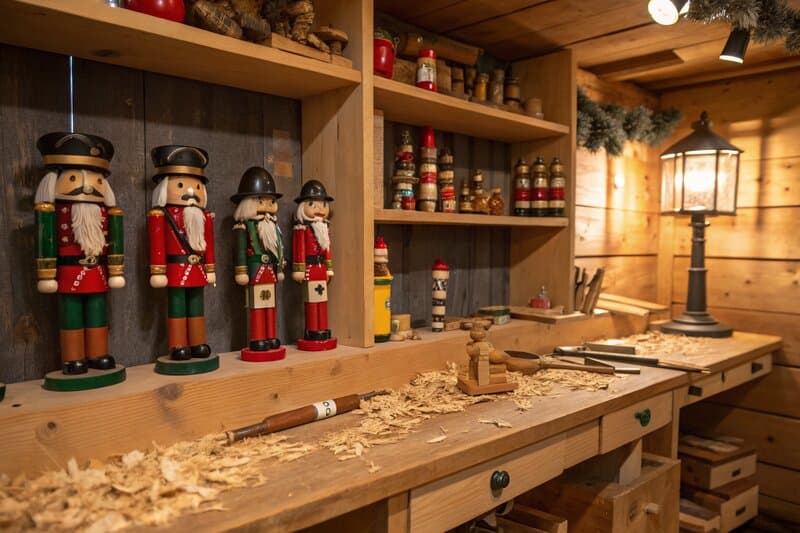
There is a mountain range on the border of Saxony and Bohemia -- the Germans call it the Erzgebirge, the Ore Mountains -- where, for three centuries, families have been turning wood into magic. Not the kind of magic I am typically accused of trafficking in, my dear reader. Something quieter. Something you can hold in your hand.
But the story of how those mountains became the cradle of the world's nutcracker tradition is darker, stranger, and more instructive than the charming narrative of folk artisans and Christmas markets that the tourism brochures prefer. Permit me to tell you the version they leave out.
The Silver That Ran Out
The Erzgebirge was not built on wood. It was built on silver.
In 1168, deposits of silver ore were discovered near what is now the town of Freiberg, triggering a mining rush that would define the region for five centuries. By the late medieval period, the Erzgebirge was one of the most productive mining regions in Europe. Towns like Annaberg, Schneeberg, Marienberg, and Freiberg swelled with miners and their families. The silver from these mountains funded the Albertine branch of the House of Wettin, financed the wars of the Holy Roman Empire, and -- in a detail that any student of economics will appreciate -- supplied the raw material for the Joachimsthaler, a silver coin minted in Joachimsthal (now Jachymov, in the Czech Republic) whose name was eventually shortened to Thaler, which is the etymological ancestor of the word "dollar."
The mountains that would one day produce the world's nutcrackers first produced the word for money itself. Remember that. It will matter later.
But silver is finite. By the seventeenth century, the richest veins were exhausted. The tin deposits that had supplemented the silver economy were also declining. The Thirty Years' War, which ravaged central Europe from 1618 to 1648, devastated the mining communities further -- towns were occupied, populations displaced, infrastructure destroyed. By the late 1600s, the Erzgebirge was in economic crisis. The ore was gone. The miners remained.
What do you do when the ground beneath your feet stops providing?
You look at what is above it.
The Forest Economy
The Erzgebirge is densely forested. Spruce, pine, beech, and linden -- particularly linden, also called limewood or Lindenholz -- blanket the mountain slopes. The miners, who had spent generations developing fine manual dexterity in cramped underground conditions, possessed exactly the skill set that woodworking demands. The transition from mining to woodcraft was not a sudden pivot but a gradual economic migration that unfolded over the late seventeenth and early eighteenth centuries.
The earliest Erzgebirge wood products were utilitarian: spoons, bowls, spindles, bobbins for the regional lace-making industry. But the market for basic wooden goods was competitive and the margins thin. The craftsmen who thrived were the ones who moved beyond utility into decoration -- who discovered that a carved figure, a painted toy, or an ornamental object could command a price far exceeding the cost of its materials.
Here is where the story becomes genuinely fascinating. The Erzgebirge woodcraft tradition did not develop in isolation. It emerged within a sophisticated commercial infrastructure inherited from the mining era. The mining guilds had established systems of quality control, apprenticeship, trade routes, and market access that the emerging woodcraft industry adopted almost wholesale. The Verleger system -- a form of merchant capitalism in which a central distributor contracted with individual home workshops -- gave individual carvers access to distant markets they could never have reached alone.
By the mid-eighteenth century, Erzgebirge wooden goods were being sold at the great trade fairs of Leipzig and Nuremberg, exported to Holland and England, and shipped as far as the Americas. The region had effectively replaced one extractive industry with another -- but this time, the resource was renewable, and the product carried the unmistakable signature of human skill.
The Guilds and Their Discipline
The woodcarving guilds of the Erzgebirge deserve more attention than they typically receive, because they explain something that casual observers of the tradition often miss: how the quality remained so consistently high across hundreds of workshops spread through dozens of villages.
The guild system imposed rigorous standards. A prospective carver began as an apprentice, typically at age fourteen, under the supervision of a master. The apprenticeship lasted three to four years and covered not only carving technique but wood selection, tool maintenance, finishing methods, and the particular conventions of the workshop's specialty. After completing the apprenticeship, the journeyman was expected to travel -- the Wanderjahre, or wander years -- working in other workshops to broaden his skills before returning to apply for master status.
The master examination was not a formality. The candidate was required to produce a masterpiece -- a Meisterstuck -- that demonstrated command of the workshop's full range of techniques. For a nutcracker carver, this might mean producing a figure of exceptional complexity: a king with multiple articulated components, fine facial detail, and flawless mechanism. The guild's existing masters evaluated the piece, and rejection was not uncommon.
This system produced something that no amount of natural talent alone could achieve: consistency across generations. A nutcracker carved in Seiffen in 1820 and a nutcracker carved in Seiffen in 1920 share a recognizable aesthetic vocabulary -- not because one copied the other, but because both emerged from the same pedagogical tradition. The guild system was, in effect, a living archive of technique, transmitting knowledge through bodies and hands rather than through written instruction.
From Tool to Figure
Now, the nutcracker itself. The device -- a hinged jaw mechanism for cracking the shells of hazelnuts and walnuts -- is ancient. Functional nutcrackers made of wood and metal appear in the European archaeological record as early as the thirteenth century. The French and English favored lever-style crackers. The Germans preferred the figurative approach: a carved figure whose jaw served as the cracking mechanism.
The earliest documented Erzgebirge nutcrackers date to the late eighteenth century, though oral tradition and circumstantial evidence suggest the form is older. These early examples were primarily functional -- the decorative carving was secondary to the mechanical purpose. A miner or a forester might own a nutcracker carved in the shape of a bearded man or a soldier, but the figure existed to crack nuts, not to sit on a shelf.
The transformation from kitchen tool to decorative object occurred gradually over the first half of the nineteenth century. Several forces drove the change. Rising prosperity in the German middle class created demand for ornamental goods that signaled cultural identity. The German Christmas tradition -- already elaborate by the early 1800s, with its trees, markets, and Advent customs -- created a seasonal market for decorative figures associated with the holiday. And the commercial success of larger, more elaborate figures demonstrated that buyers would pay a premium for a nutcracker that had personality.
Consider the economics. A simple functional nutcracker might sell for a few Groschen. A nutcracker carved in the form of a Prussian king, with painted uniform, rabbit-fur beard, and a jaw that opened with satisfying authority, might sell for several times that amount. The additional labor required to produce the decorative version was modest compared to the price premium it commanded. The incentive was clear.
By the time E.T.A. Hoffmann published The Nutcracker and the Mouse King in 1816, the decorative nutcracker was already a familiar presence at German Christmas markets. Hoffmann, who lived in Berlin and was a frequenter of markets and fairs, almost certainly encountered Erzgebirge nutcrackers. His story, with its magical transformation of a wooden nutcracker into a living prince, draws on a cultural artifact his readers would have recognized immediately.
The question of whether Hoffmann's tale increased demand for decorative nutcrackers or merely reflected existing demand is one that historians enjoy debating. But here is what they do not tell you: it does not matter. What matters is the convergence -- the moment when a functional object, a literary archetype, and a commercial opportunity aligned to produce something that transcended all three. The nutcracker became a symbol. And symbols, unlike silver, do not run out.
The Dark Century
The nineteenth century was the golden age of Erzgebirge woodcraft. But the twentieth century brought catastrophe.
The First World War disrupted export markets and conscripted young carvers. The interwar period brought economic instability and the rise of industrial competition. The Second World War was worse -- the Erzgebirge's proximity to the Czech border made it a zone of military significance, and many workshops were repurposed for war production.
But the deepest wound was political. After 1945, the Erzgebirge fell within the Soviet occupation zone, becoming part of the German Democratic Republic. The East German state collectivized the workshops, organizing independent carvers into production cooperatives -- Produktionsgenossenschaften des Handwerks, or PGH. Individual artisans lost control over their designs, their production methods, and their market relationships. Quotas replaced craft judgment. Standardization replaced individuality.
Not all of this was destructive. The cooperatives provided economic stability during a period of extreme uncertainty, and the GDR's export agency, which marketed Erzgebirge crafts to the West through carefully controlled channels, ensured a steady income for many families. But the soul of the tradition -- the guild system's emphasis on individual mastery, the workshop's identity as expressed through its particular style -- was damaged in ways that took decades to become fully visible.
German reunification in 1990 liberated the workshops from state control but exposed them to global market forces they were unprepared for. Cheap mass-produced nutcrackers from China flooded the market. Consumers who could not tell the difference between a hand-carved Erzgebirge original and a factory reproduction chose the cheaper option. Young people left the mountain villages for opportunities in Dresden, Leipzig, and Berlin.
What Endures
And yet.
The workshops of Seiffen, Olbernhau, and the surrounding villages still operate. The Fuechtner family still carves. The Wendt and Kuhn workshop, founded in 1915, still produces figures of extraordinary delicacy. The annual Seiffen Christmas market still draws tens of thousands of visitors who come not for novelty but for continuity -- for the assurance that somewhere, someone is still doing this.
The tradition endures not because it is efficient -- mass production is faster, cheaper, and more consistent. It endures not because of nostalgia, though nostalgia helps sell tickets to the Christmas market. It endures because the object it produces -- a carved figure that cracks nuts, or pretends to, with the expression of a king who takes his absurd duty seriously -- carries within it the residue of three hundred years of human persistence.
A nutcracker from the Erzgebirge is, if you know how to read it, a compressed history. The wood is from the same forests that sheltered miners in the seventeenth century. The technique was transmitted through guild apprenticeships that stretch back to the eighteenth century. The form -- the soldier, the king, the gendarme with his bristling mustache -- codified in the nineteenth century and defended through the catastrophes of the twentieth.
When you hold one, you are holding all of that. The silver that ran out. The forests that provided. The guilds that insisted on standards. The families that adapted, survived, adapted again. Three hundred years of answering the same question -- what do you do when the ground gives out? -- with the same answer: you make something beautiful from what remains.
But that, as they say, is a story for another evening. The candles are low, and I have kept you long enough. For now.