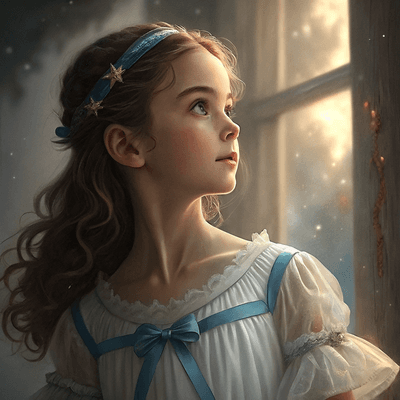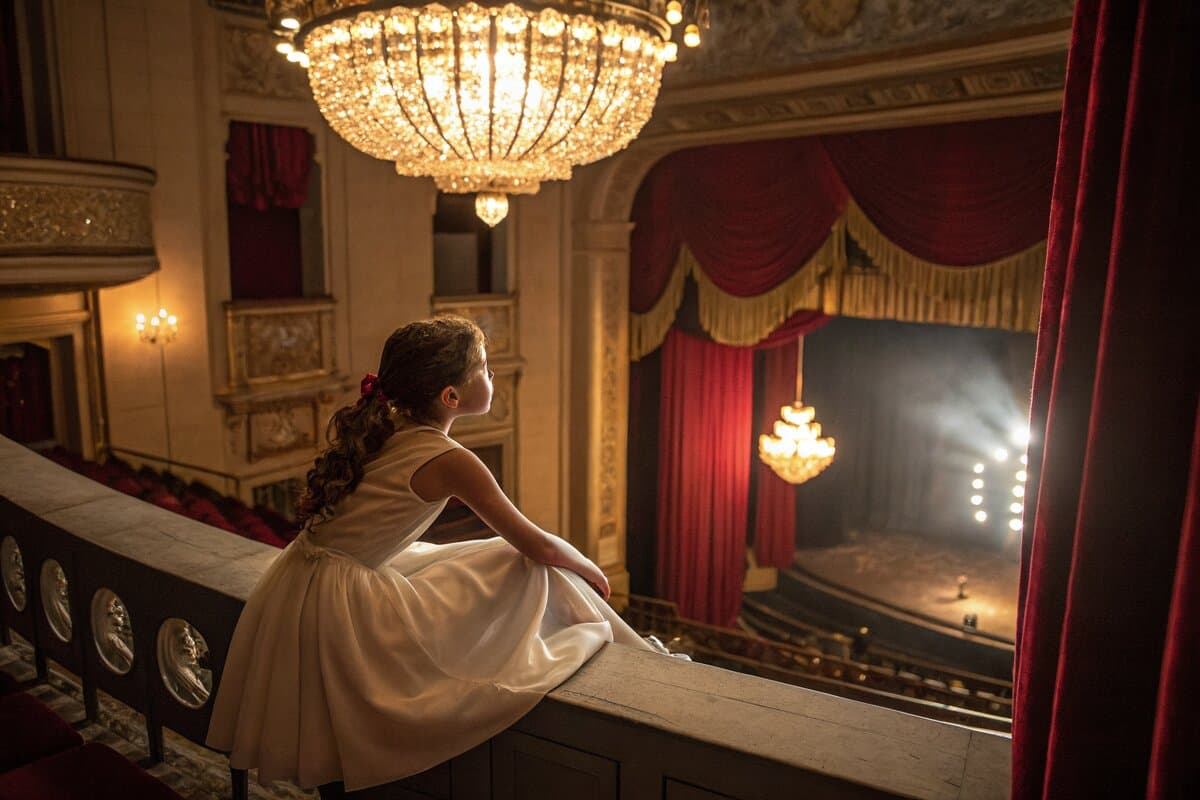
I was seven years old the first time the lights went down, and I have never quite come back from that darkness.
I do not mean that dramatically. Or maybe I do. Let me try to explain.
My mother had been talking about it for weeks. She kept calling it "an experience," which is what parents say when they want you to understand that something is important but cannot quite tell you why. She bought me a new dress -- dark green velvet with a satin ribbon at the waist -- and I remember the way it felt against my arms as we walked through the lobby of the theater. Scratchy and important.
The lobby itself was the first astonishment. I had never been inside a proper theater before. Our town had a performing arts center that hosted school assemblies and the occasional traveling magic show, but this was something else entirely. Chandeliers. Actual chandeliers. The ceiling was painted with clouds and angels, and I stopped walking and looked up until my mother tugged my hand.
"Come on, Clara," she said. "We need to find our seats."
Our seats were in the mezzanine, which felt like being a bird. The stage was far below us, hidden behind a curtain of deep red velvet -- the same color as the seats, the same color as the carpet, as if the whole theater was a single living room and the curtain was just the closed door to the most interesting part.
And then.
The lights went down.
Not all at once. They dimmed, the way daylight fades on a winter afternoon -- slowly at first, then faster, and then you realize it is dark and you cannot remember exactly when it happened. The murmuring stopped. Someone coughed. And in that silence -- in that held breath between the last whisper and the first note -- I felt something I had never felt before.
I felt the room lean forward.
Two thousand people, all of them strangers to me, all of them holding their breath at the same time. All of them waiting for the same thing. I did not know then that this was the overture. I did not know that the music was by a Russian man named Tchaikovsky who had written it more than a hundred years before I was born, or that he had not especially liked it, or that it would become the most performed ballet in the world. I knew none of that. I only knew that when those first notes rose from the orchestra pit -- tentative, twinkling, like someone opening a music box very carefully -- something inside me opened too.
The Party Scene
The curtain rose on a party. A Christmas party.
I should tell you that I did not immediately understand what was happening. The stage was full of people in old-fashioned clothes, and they were doing something that looked like walking but was not walking -- it was too precise, too beautiful, too deliberate. Later I would learn this was called choreography, but at seven I just thought everyone at this party was unusually graceful.
There were children on stage. That got my attention. A girl in a white dress -- and I know this sounds convenient, but I swear she looked like me, or at least like the version of me I wanted to be -- was opening presents and laughing silently, her mouth forming shapes my ears could not hear because the orchestra was too full, too everywhere.
And then there was a man. A strange man. He moved differently from everyone else -- slower, more deliberately, as if he knew something the others did not. He wore a dark cloak, and he had this way of looking at the audience as if he could see us even though the lights were in his eyes.
He brought the nutcracker.
When I saw it -- when the girl in the white dress held up this painted wooden soldier and looked at it with the kind of love you usually save for living things -- I felt my throat go tight. Not because it was sad. Because it was true. I knew that feeling. I had dolls I loved like that. I had a stuffed rabbit whose ear I had accidentally torn and cried about for two days. I knew what it meant to love a thing.
The Moment It Became Real
There is a moment in The Nutcracker -- and if you have seen it, you know the one I mean -- when the stage goes dark after the party and Clara (the Clara on stage, not me, though by that point the distinction was blurring) sneaks downstairs to check on her nutcracker.
The tree grows.
I need you to understand that I did not know this was going to happen. No one had warned me. The Christmas tree, which had been a normal-sized prop in the party scene, began to rise. It grew and grew, the ornaments rising past the stage, the star climbing toward the ceiling, and the girl -- Clara, me, whoever she was -- shrank beneath it.
I grabbed my mother's hand.
"It's okay," she whispered. "Watch."
I watched. The tree grew. The room changed. And a girl who had been standing in a living room was suddenly standing in a world that obeyed different rules, a world where toys came to life and mice wore crowns and a wooden soldier could become a prince.
I did not know, at seven, that this was a metaphor for growing up. For the way childhood looks when you are standing inside it versus when you are standing above it. I did not know that the growing tree was really about perspective -- about the way the world expands when you are brave enough to stay up past midnight and see what happens.
I just knew it was the most beautiful thing I had ever seen.
What I Want You to Know
I have seen The Nutcracker many times since then. I have seen it performed by world-class companies and by local dance schools where the mice tripped over their tails and the tree only grew halfway because the mechanism got stuck. I have seen it in grand theaters with gilded ceilings and in high school auditoriums with folding chairs. I have seen versions that made me weep and versions that made me wince.
None of them -- not one -- has erased that first time.
This is what I want you to know, especially if you are reading this and have never seen it. Especially if you are thinking about taking your child, or your niece, or your friend who has never been to the ballet, and you are wondering if it is worth it. If they will like it. If they will understand it.
They might not understand it. I certainly did not. I did not know what an arabesque was. I did not know the difference between the Dance of the Sugar Plum Fairy and the Waltz of the Flowers. I did not know that the woman in the second act who seemed to float on air was dancing on the tips of her toes, which is physically unreasonable and yet she did it anyway, because ballet is the art of making impossible things look effortless.
I did not understand any of that. But I felt it. And that was enough.
The ballet does not ask you to understand it. It asks you to sit in the dark and feel the room lean forward. It asks you to let a tree grow. It asks you to believe, for two hours, that a wooden soldier can become a prince, and that the bravest thing a girl can do is love something enough to fight for it.
An Invitation
If you have a first-time story of your own, I want to hear it. What were you wearing? What do you remember about the lobby? Did the tree surprise you too?
Write to us. Mother Ginger collects these stories like treasures, and there is no story too small. The girl who sat three rows behind you might have had her life changed that night, just as you did. We are all connected by that darkness, by that held breath, by the first note.
And if you have not yet had your first time -- if you are still waiting, still wondering -- then let me say this: go. Do not wait for the right moment or the right company or the right seat. Just go. Sit in the dark. Let the lights go down.
Something will open in you that you did not know was closed.
And if you listen closely enough -- past the applause, past the rustle of coats in the lobby -- you can still hear it. The music never really stops. It just waits for you to remember.