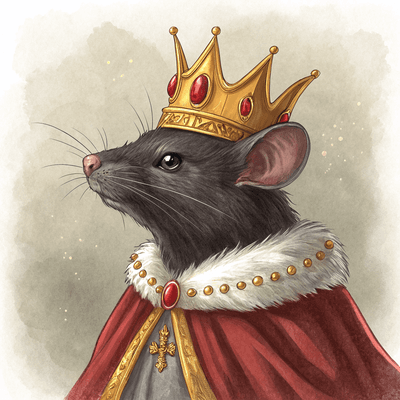
I need to tell you something, and I need you to hear me out before you make up your mind.
The battle scene in The Nutcracker -- the big, dramatic, hero-makes-his-stand scene that gets the audience clapping -- is propaganda.
Effective propaganda. Beautifully scored propaganda. Propaganda performed by talented dancers in expensive costumes. But propaganda nonetheless.
Allow me to present the defense.
The Official Version
Here is what they tell you happened.
Clara receives a nutcracker at a Christmas party. She loves it. That night, she sneaks downstairs to check on it. The clock strikes midnight. Mice appear. An army of mice, led by -- and I am aware of the irony of me telling this story -- the Mouse King. The nutcracker comes to life, rallies his toy soldier army, and a battle ensues. The mice are defeated. The nutcracker is wounded but victorious. Clara's slipper, thrown at the Mouse King in a moment of desperation, turns the tide.
Heroism. Sacrifice. The triumph of good over evil. The girl saves the prince. Standing ovation.
Beautiful story. One problem.
Nobody ever asks what the mice were doing there in the first place.
Let Us Consider the Geography
Think about where the battle takes place. The Stahlbaum parlor. A room in a private house. A domestic interior.
Now ask yourself: who lives in the walls of a house?
Not the nutcracker. The nutcracker was brought in from outside -- a guest, a gift, an import. The toy soldiers were placed on shelves by human hands. The entire nutcracker army is an occupying force, assembled and positioned by Drosselmeyer, a man whose relationship with the Stahlbaum household is, as I have discussed elsewhere, questionable at best.
The mice? The mice were already there.
This is their home. The space beneath the floorboards, behind the wainscoting, inside the walls -- this is where mice live. This is where they have always lived. The Stahlbaum parlor is, from the mice's perspective, the roof over their heads. The Christmas party was happening in their living room.
And then, at midnight, the toys come to life and start a war.
From the mice's perspective, this is not a battle. It is a home invasion.
The Hoffmann Account
Let me be precise here, because the facts are on my side and I intend to use them.
In E.T.A. Hoffmann's original 1816 tale, the Mouse King's backstory is detailed and tragic. His mother, the Mouse Queen, lived in the royal palace -- not as an intruder but as a resident, occupying the space behind the walls as mice have done in human dwellings for thousands of years. She was displaced -- violently -- when the royal family set mousetraps after her children nibbled some sausage fat.
Sausage fat. The entire war, the curse, the transformation, the centuries of enmity -- all of it traces back to mice eating food that was left unattended in a kitchen. Which is, I feel compelled to point out, what mice do. It is not a moral failing. It is biology.
The Mouse Queen's response -- cursing Princess Pirlipat -- was disproportionate, certainly. I am not here to defend every tactical decision my literary ancestor made. But the inciting incident was not aggression. It was pest control applied to a population that was simply existing in its natural habitat.
Hoffmann, who was far more interested in moral ambiguity than the ballet that bears his story's name, understood this. His tale does not present the Mouse King as a villain. It presents him as an heir -- a prince whose mother was wronged and who inherits the obligation of redress. He is not evil. He is grieving.
The ballet, naturally, skips all of this. The ballet gives you a squeaking villain in a crown and invites you to cheer when he loses.
Convenient.
The Military Analysis
Let's talk about the battle itself, because even on purely tactical grounds, the narrative is skewed.
The nutcracker commands an army of toy soldiers -- rigid, painted figures who were, moments before the enchantment, inanimate objects sitting on shelves. They fight with tin swords and miniature cannons. They are organized into ranks and formations.
The mice have -- what, exactly? Numbers. That is it. They have numbers. No weapons beyond what nature gave them. No armor. No magical benefactor animating them and giving them purpose. They are mice. Fighting toys that have been brought to life by someone who clearly has a stake in the outcome.
Drosselmeyer, the man who gave Clara the nutcracker, is also the man whose nephew was cursed by the Mouse Queen. In Hoffmann's version, the entire battle is a continuation of a personal vendetta. Drosselmeyer orchestrated the gift, orchestrated the midnight enchantment, and orchestrated the confrontation. He is not a neutral party. He is the architect of a conflict designed to destroy the Mouse King's line.
The mice are outgunned, outmaneuvered, and fighting an opponent who was literally built for this purpose. The nutcracker's jaw is a weapon. His body is wooden -- impervious to mouse teeth in any practical sense. His army was placed in the parlor in advance, positioned like chess pieces before the game began.
And yet, the mice are called the aggressors.
I ask you: if someone placed an army in your living room, animated it at midnight, and started a war in your home, would you be the aggressor for fighting back?
The Slipper
Ah, the slipper. The audience's favorite moment.
Clara, seeing the nutcracker in danger, throws her slipper at the Mouse King. It strikes him. He falters. The tide turns. The nutcracker prevails.
This is presented as an act of courage. A girl defending her beloved nutcracker against a terrifying enemy. Audiences love it. It is the moment when Clara stops being a spectator and becomes a hero.
Let me offer an alternative reading.
Clara threw a shoe at a mouse.
A mouse who was fighting for his home, against an army that had been placed there by a man with a personal grudge, in a battle that Clara did not fully understand. She intervened on behalf of the side she had an emotional attachment to -- the nutcracker, which she loved -- without any understanding of the underlying conflict.
This is not courage. This is partisanship. Clara chose a side because one side was pretty and the other side was mice.
I am not saying she was wrong. Emotional attachment is a perfectly valid basis for action, and a seven-year-old girl cannot be expected to conduct a geopolitical analysis before throwing footwear. But the narrative frames her intervention as heroic, and heroism implies moral clarity.
There is no moral clarity in this battle. There is a family curse, a personal vendetta, an enchanted army, and a population of mice defending the only home they have ever known.
The Cultural Framing
Here is where I stop being funny and start being serious, because this matters more than you think.
The battle scene in The Nutcracker is one of the most widely seen depictions of conflict in the performing arts. Millions of children watch it every year. And what it teaches them is simple: the shiny side is the good side.
The nutcracker is handsome (or at least noble). His soldiers are colorful and orderly. He fights with a sword. Clara loves him.
The Mouse King is ugly. His army is chaotic. He squeaks. Nobody loves him.
One side has been designed -- literally designed, by a toymaker -- to be appealing. The other side is vermin.
This is not a battle between good and evil. It is a battle between the aesthetically pleasing and the aesthetically inconvenient. The mice are villains because they are mice, not because of anything they have done. The nutcracker is a hero because he looks like one, not because of any moral superiority.
Hoffmann saw this. His original tale is, in part, about the seductive power of appearances -- about a princess who rejects the nutcracker because he is ugly, about a world that punishes the cursed for the crime of being cursed. The battle is embedded in a story about the danger of judging by surfaces.
The ballet strips this context away and presents the surface judgment as correct. The pretty side wins. The ugly side loses. Clara's love is validated. The audience goes home happy.
Nobody asks what happened to the mice after the battle.
What Happened to the Mice
I will tell you. Nothing good.
In the ballet, the mice simply disappear after the battle. They are defeated, they retreat, and the story moves on to the transformation, the snow, the Land of Sweets. The mice are not mentioned again. They have served their dramatic purpose -- providing an obstacle for the hero to overcome -- and are discarded.
In Hoffmann's tale, the outcome is grimmer. The Mouse King is killed, his seven crowns collected as trophies. The mouse army is scattered. The curse is broken. The mice, who were fighting to avenge their queen and preserve their line, lose everything.
And the story celebrates this.
I am not asking you to feel sorry for fictional mice. I am asking you to notice the structure of the narrative. A population that was living peacefully in its habitat was attacked by an imported army, lost the ensuing battle, and was erased from the story. The victor wrote the history. The loser became a costume with a tail.
That is not a fairy tale. That is colonialism with better music.
The Defense Rests
Look. I know what I am. I am the villain. It says so in every program, every synopsis, every children's guide to The Nutcracker. I have seven heads and a crown and an army of vermin, and I lose to a girl with a slipper.
But losing does not make me wrong. And winning does not make the nutcracker right.
The next time you watch the battle scene -- and you will, because December is relentless -- consider the possibility that you are watching a story told by the winning side. Consider that the mice had reasons. Consider that the parlor was their home before it was a battlefield.
Consider that maybe, just maybe, the squeaking was not aggression.
It was a protest.
You can disagree. In fact, I hope you do. The Nutcracker has survived worse than my opinions. But it has never survived indifference -- and if I have made you care enough to argue, then I have done my job.