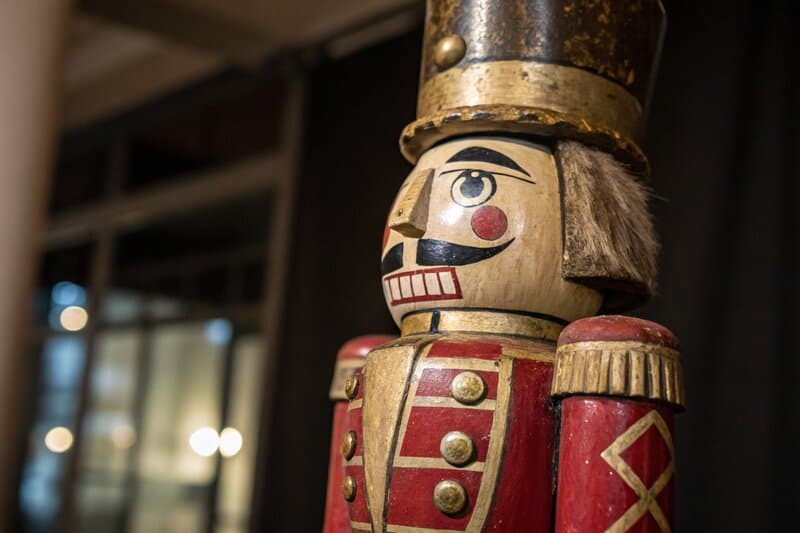
My grandmother kept hers on the mantelpiece, between a brass candlestick and a porcelain bell that nobody was allowed to ring. He was a king -- red coat, gold crown, a beard that had gone slightly yellow with age, the way real beards do. His jaw still worked, though it stuck a little on the left side, and one of his boots had a chip where my uncle had dropped him in 1974.
She never told me his name. I gave him one anyway: Frederick. I do not remember why.
Every December, when the box of Christmas things came down from the attic, Frederick appeared first. Before the garland, before the stockings, before the star for the tree. My grandmother would unwrap him from the same sheet of tissue paper -- I am certain it was the same sheet, refolded every January -- and set him in his place on the mantel. She would adjust his position twice. Then she would step back and look at him, and her face would do something I did not have a word for as a child.
I have a word for it now. It is called remembering.
The Weight of Wooden Things
There is something about a nutcracker that invites accumulation. Not dust, though certainly that too. I mean the accumulation of meaning. Of years. Of the quiet, layered weight that comes from being present at many Christmases without ever changing.
The nutcracker does not age the way other decorations do. A glass ornament yellows. A wreath dries out. Tinsel loses its shine. But a nutcracker made of linden wood and paint and rabbit fur exists in a kind of stubborn permanence. The colors may soften. The jaw may loosen. The fur may thin. But the figure remains recognizably, unmistakably itself -- the same stern face, the same wide eyes, the same posture of comic authority that it had the year it was made.
This is why, I think, nutcrackers become heirlooms in a way that other Christmas objects do not. They outlast their context. The tree is different every year. The wrapping paper is used and discarded. The cookies are eaten. But the nutcracker stands on the same shelf, in the same position, watching the same family change around it. Children grow. Parents age. Someone moves away. Someone new arrives. The nutcracker sees it all and says nothing, which is the correct response to the passage of time.
A Grandmother's Christmas
My friend Anna has a nutcracker that belonged to her grandmother in Stuttgart. It is a soldier -- not a king, a proper Prussian soldier with a blue coat and a sword that broke off decades ago. The paint on his face is cracked in a way that makes him look like he is squinting, as though he has been staring at Christmas lights for seventy years and is tired of it.
Anna's grandmother brought him to America in 1953, packed inside a suitcase between wool sweaters and a Bible. Anna does not know where her grandmother acquired him, or how old he was even then. What she knows is this: her grandmother placed him on the windowsill every December, without fail, for forty-one years. When her grandmother died, the nutcracker went to Anna's mother. When her mother moved to a smaller apartment, it went to Anna.
"I don't actually like him," Anna told me once, laughing. "He's sort of ugly. His jaw doesn't work anymore. He's missing a hand."
She keeps him on her mantelpiece. Every December. Without fail.
This is what an heirloom does. It is not about beauty or function. It is about continuity -- the physical proof that someone you loved once held this same object, placed it in this same position, felt this same peculiar tenderness toward a painted piece of wood. The nutcracker is a bridge. You stand on one side, and your grandmother stands on the other, and the distance between you is exactly the length of a wooden soldier.
What Passes Through Hands
I have been collecting these stories, the way Mother Ginger collects everything -- by listening.
A woman in Ohio told me about a nutcracker her father carved himself in the 1960s, working from a pattern he found in a woodworking magazine. It is rough. The proportions are wrong -- the head is too large, the base too narrow, and the jaw mechanism never worked properly. It has no monetary value. She turned down two hundred dollars for it at an estate sale and felt insulted by the offer.
A man in Vermont told me about a set of three nutcrackers -- a king, a soldier, and a guardsman -- that his parents bought at a German Christmas market in Nuremberg in 1988. They carried them home in a cardboard box, padded with newspaper, on a flight from Frankfurt to Boston. One of the newspapers, a copy of the Nurnberger Nachrichten dated December 12, 1988, is still in the box. He keeps the newspaper too.
A teenager wrote to us about inheriting her great-aunt's nutcracker collection -- fourteen figures, ranging from a six-inch drummer to a two-foot king. She had never met her great-aunt. She did not know what to do with fourteen nutcrackers. She displayed them anyway, all fourteen, on a bookshelf in her bedroom. "They feel like they belong to someone," she wrote. "I thought maybe if I kept them together, that someone could still visit."
I read that sentence and had to put my phone down for a moment.
The Chip, the Crack, the Missing Sword
Here is what I have noticed about heirloom nutcrackers: people always describe the damage first.
Not the original colors, not the craftsmanship, not the height or the design. The damage. "He has a chip on his boot." "The crown is cracked." "He lost his sword in the eighties." "One eye is a slightly different shade of blue because my dad repainted it."
This tells me something important. The damage is not a flaw in the heirloom. The damage is the heirloom. The chip on the boot is the Christmas of 1974, when Uncle Steve knocked the mantel reaching for the eggnog. The missing sword is the afternoon in 1986 when two cousins fought over who got to hold the nutcracker, and the sword was the casualty. The repainted eye is a father, sitting at the kitchen table with a tiny brush and a jar of acrylic paint, trying to fix something for his daughter.
Every mark on an heirloom nutcracker is a date. A name. A room. A feeling. The figure is made of wood, but the story it carries is made of something softer and more durable.
What I Keep
I should tell you about mine.
He is not old. He is not German. He is not even, by any collector's standard, particularly well made. He is a nutcracker I found at a craft fair when I was nineteen, the first Christmas I spent away from home. He was on a table between a jar of homemade jam and a stack of knitted dishcloths, and he cost twelve dollars. He is a soldier in a green coat, about ten inches tall, with a jaw that works beautifully and a face that looks permanently startled, as if he has just realized something important.
I bought him because I missed my grandmother's Frederick, who by that point was three states away and an impossible drive in December weather. I bought him because I needed a nutcracker on a shelf, and it did not matter that it was not the same shelf or the same nutcracker or the same December. What mattered was the ritual. The placing. The stepping back. The looking.
He has been with me for every Christmas since. He has lived in dorm rooms, apartments, a house I rented for two years that had mice in the walls, and the place I live now. He has a small dent on the back of his head from a move in 2019 when the box was handled carelessly. I could fill the dent with wood putty. I will not. That dent is 2019.
Someday, if I am fortunate, he will go to someone who will put him on a shelf and step back and feel the thing my grandmother felt. The thing Anna feels. The thing that woman in Ohio feels about a lopsided nutcracker with a jaw that never worked.
The feeling that you are holding something that has already been loved, and that loving it again is the simplest and most important thing you can do.
And if you have a nutcracker like that -- one with a history, one with a chip or a crack or a story -- I want to hear about it. Not because I am collecting data. Because I am collecting proof that the things we love the most are never the things that are perfect. They are the things that stayed.