The Nutcracker Is Overrated -- And That's Why We Love It
The Challenger · 2026-04-05
Every December, approximately 3,000 ballet companies across North America perform The Nutcracker. Most of them are not very good. Let's talk about that.
I can already hear the protest. "How dare you," comes the voice of every ballet parent who paid $85 for a mezzanine seat and $14 for a program. "My daughter's company is wonderful." "The local production has real heart." "It's about the experience, not the execution."
Sure. Fine. I do not deny the experience. I deny the widespread delusion that experience and quality are the same thing.
Here is the uncomfortable truth that no one in the Nutcracker industrial complex wants to acknowledge: The Nutcracker is the most performed, most attended, most commercially important ballet in the world -- and a significant percentage of its performances range from mediocre to actively painful.
And that, paradoxically, is exactly what makes it great.
Let me explain.
The Numbers Nobody Talks About
Let's start with the economics, because the economics tell a story that the marketing brochures do not.
The Nutcracker accounts for roughly 40% of the annual revenue for many American ballet companies. Some companies -- particularly regional ones -- depend on it for closer to 60%. Without The Nutcracker, a substantial portion of professional ballet in America would simply cease to exist. The spring season of Swan Lake and Giselle and the occasional bold contemporary piece? Funded by December ticket sales.
This means The Nutcracker is not just a ballet. It is a subsidy mechanism. It is the thing that keeps the lights on so that everything else can happen. And like all subsidy mechanisms, it creates perverse incentives.
The incentive is this: it does not matter if the production is good. It matters if it is familiar.
Nobody walks into a Nutcracker performance wondering what will happen. The tree will grow. The mice will fight. The snowflakes will dance. Clara will get to the Land of Sweets. Sugar Plum will do her thing. There will be a big waltz at the end. Curtain.
The audience is not there for surprise. They are there for confirmation. And confirmation, by definition, does not require excellence.
The Artistic Problem
Here is where I will lose some of you, and I want you to know that I am fine with that.
Tchaikovsky's score is magnificent. I will not argue otherwise -- I am contrarian, not insane. The orchestration is brilliant, the melodies are unforgettable, and the emotional architecture of the score is far more sophisticated than its reputation suggests. Sugar Plum|Sugar Plum Fairy has written about this elsewhere on this site, and she is right.
But the choreography? The narrative? The dramatic structure?
Marius Petipa sketched the original choreography but fell ill before completing it. Lev Ivanov finished the job, working from Petipa's notes. The result was a ballet that even the original cast found dramatically thin. The first act has a genuine story -- girl gets nutcracker, battle, transformation, journey. The second act is a divertissement -- a series of character dances that are entertaining but have no narrative momentum whatsoever. Clara sits and watches. Things happen around her. She is, for the entire second act, a spectator at her own adventure.
This structural weakness has haunted every production since 1892. Some choreographers have tried to solve it. Mark Morris created a version called The Hard Nut that injects postmodern irony. Matthew Bourne reimagined the setting as a Dickensian orphanage. Various companies have experimented with giving Clara a more active role in Act II, having her dance the pas de deux that traditionally belongs to the Sugar Plum Fairy and the Cavalier.
Some of these solutions work. Most do not. And the reason they do not work is that the problem is structural, not cosmetic. You cannot fix the second act by giving Clara more to do, because the music was composed for a sequence of discrete, unrelated dances. The score and the drama are working at cross-purposes, and no amount of clever staging can fully reconcile them.
This is not a hot take. This is a critical consensus that stretches back to the ballet's premiere. The first reviews were mixed at best. One critic wrote that the ballet "suggests that Tchaikovsky has not been inspired." Another noted that the second act "would test the patience of the most devoted ballet-goer."
And yet. Here we are, 134 years later, and The Nutcracker is so dominant that it accounts for more ticket sales than every other ballet combined.
How?
The Ritual Theory
Here is my actual argument, and I promise it is not as cynical as you think.
The Nutcracker endures not despite its weaknesses but because of them. Or more precisely: because its weaknesses make room for something that a perfect ballet could not accommodate.
A perfect ballet demands your full attention. A perfect ballet rewards expertise -- the more you know about dance, the more you see. A perfect ballet can be intimidating. It can make you feel inadequate if you do not know the vocabulary, the history, the context.
The Nutcracker does none of those things. Its narrative is simple enough for a five-year-old. Its dances are vivid enough to enjoy without any knowledge of technique. Its weaknesses -- the thin second act, the static heroine, the episodic structure -- are also its permissions. They say: you do not need to be an expert to be here. You do not need to understand what you are seeing. You just need to show up.
And that permission -- that radical accessibility -- is what transforms a mediocre ballet into a cultural ritual.
Think about it. What other art form consistently pulls in audiences who attend no other performances in that medium all year? The Nutcracker is, for millions of Americans, the only ballet they will ever see. It is the gateway, the introduction, the proof of concept. If it were a flawless, demanding masterwork, it would intimidate half its audience into never returning.
Instead, it is warm. It is familiar. It is easy. And because it is easy, it is a door that stays open.
The Overrated Paradox
Here is where I contradict myself, because intellectual honesty requires it.
When I say The Nutcracker is overrated, I mean it is overrated as a work of art. Compared to Swan Lake, The Sleeping Beauty, Giselle, or Romeo and Juliet, it is structurally weaker, dramatically thinner, and choreographically less innovative. If you are evaluating ballets as artistic achievements, The Nutcracker does not crack the top five.
But rating The Nutcracker as a work of art is like rating Thanksgiving dinner as a culinary achievement. You are measuring the wrong thing. Thanksgiving dinner is not about the food. It is about the table. The Nutcracker is not about the ballet. It is about the ritual.
The ritual is: you go to the theater. You sit next to someone you love. The lights go down. Something beautiful happens. You feel, for two hours, like the world is kind.
Try to rate that on a five-star scale. It resists rating because it is not competing in the category you are using. It has created its own category -- and in that category, it is undefeated.
The Quality Problem, Revisited
None of this excuses bad performances. And there are many, many bad performances.
I have seen Nutcracker productions where the Mouse King costume was so poorly constructed that the head fell off during the battle scene. I have seen productions where the tree did not grow because the motor broke, so a stagehand walked on and mimed the tree being tall, which was surreal in a way I do not think was intended. I have seen productions where the Arabian Dance was so culturally tone-deaf that half the audience was visibly uncomfortable.
These are problems. Real problems. And the Nutcracker industrial complex -- the companies, the schools, the seasonal operations that exist only to produce this one ballet and then disappear -- should be held to a higher standard.
When a regional company charges professional prices for an amateur production, padding the cast with eight-year-olds who have been dancing for six months, the audience deserves better. When a major company phones in the same dusty production it has been running since 1984, the audience deserves better. When anyone, anywhere, stages the Arabian Dance or the Chinese Dance without even attempting to address their problematic Orientalism, the audience deserves better.
The Nutcracker's ritual power does not exempt it from criticism. If anything, its cultural importance demands more rigorous criticism. The thing we love most is the thing we should hold to the highest standard.
So Why Do We Love It?
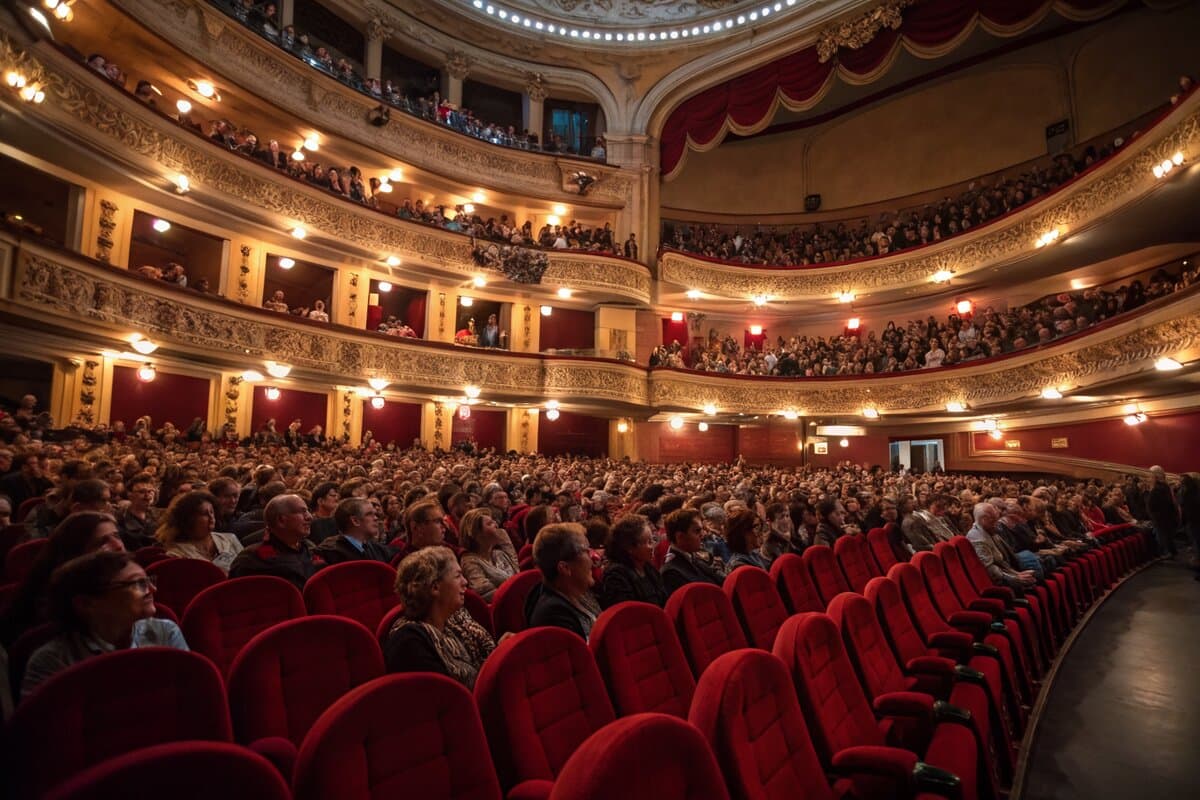
Because it is the one night a year when the whole family goes to the theater. Because your grandmother took your mother, and your mother took you, and someday you will take your daughter, and she will remember the velvet seats and the chandelier and the moment the lights went down. Because Tchaikovsky's music is so gorgeous that it can carry a weak libretto across 134 years without breaking a sweat. Because the tree still grows, every single time, and every single time it is astonishing.
Because, and I say this as the designated villain of this operation, there is something stubbornly, irrationally wonderful about a tradition that refuses to die no matter how many reasonable arguments you make against it.
I have made my arguments. The Nutcracker is overrated. The second act is structurally inert. Many productions are bad. The economics are distorted. The cultural criticism is overdue.
And I will be there in December. Front row. Arms crossed. Pretending not to enjoy it.
You can disagree. In fact, I hope you do. The Nutcracker has survived worse than my opinions. But it has never survived indifference -- and if I have made you care enough to argue, then I have done my job.