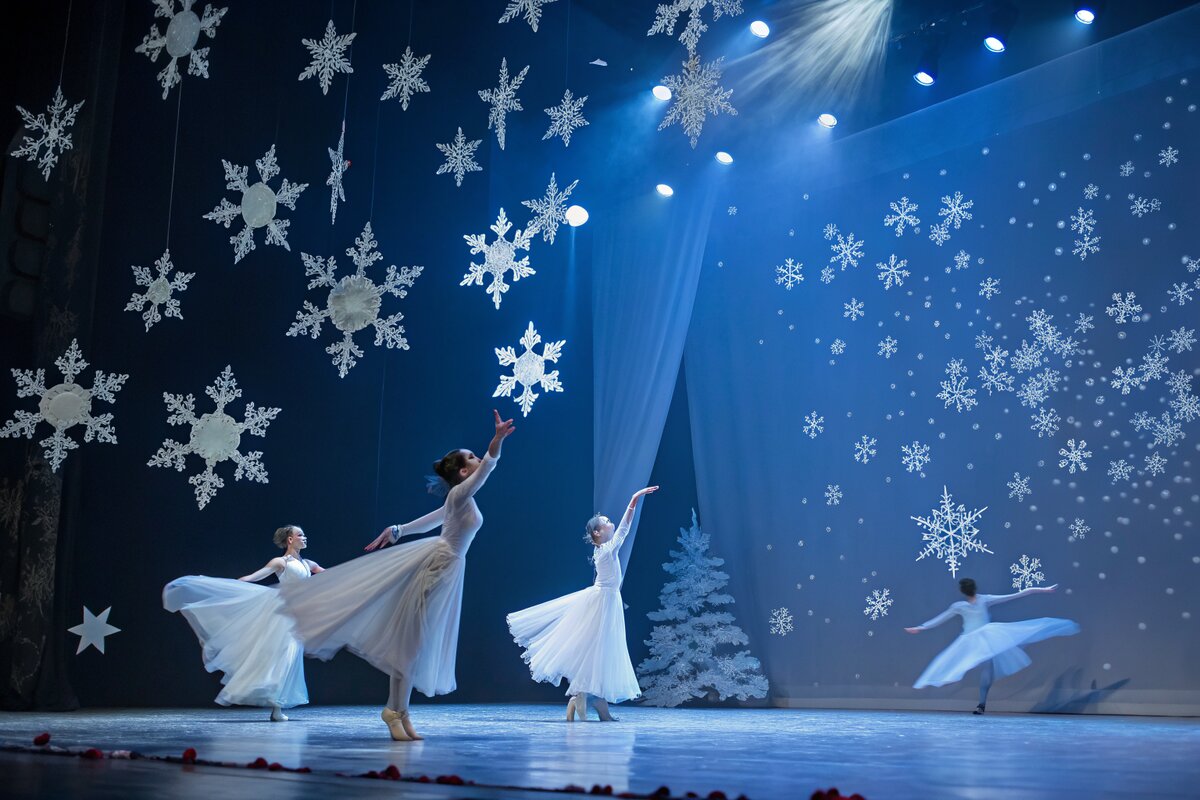
Forty-eight dancers in white.
The stage, bare.
Then -- a single flake, turning in the light.
The Waltz of the Snowflakes is the last scene of Act I, and it is the scene that stays. Not in the mind, exactly. Somewhere lower. In the chest. In the part of you that responds to falling things -- leaves, rain, light through a window at four in the afternoon in December.
It lasts approximately six minutes, though time behaves differently inside it. Six minutes is what the clock says. What the body says is: it lasted the length of a held breath. Or: it lasted a winter.
Both are true.
The Architecture of Falling
Tchaikovsky scored the Waltz of the Snowflakes for full orchestra and a hidden choir. This is unusual. In the rest of The Nutcracker, the human voice is absent -- the story is told entirely through instruments and movement. But here, at the threshold between the known world and the Land of Sweets, Tchaikovsky introduces wordless voices singing in E-flat major.
The choir does not sing words. It sings vowel sounds -- open, sustained, hovering above the orchestra like something that cannot quite be named. The effect is disorienting in the best possible way. The voices are not characters. They are atmosphere. They are the sound of cold itself, if cold could sing.
Beneath the choir, the strings play a waltz, but it is a waltz that keeps dissolving. The melody begins, establishes itself, then fragments into tremolo -- a rapid repetition that creates a shimmering, unstable texture, like looking at a landscape through falling snow. The wind instruments enter and withdraw. The harp glitters at the edges.
What Tchaikovsky understood is that snow does not march. It does not arrive with announcement or fanfare. It accumulates. It builds not through force but through persistence. And so his waltz does the same -- it gathers, layer over layer, voice over voice, until the sound is thick and white and everywhere.
What the Dancers Become
The corps de ballet in the Waltz of the Snowflakes faces a particular challenge: they must stop being people.
This is not metaphor. It is technique. In most ballet scenes, the corps functions as a chorus -- a group of individuals performing synchronized movements while retaining some sense of individual presence. Faces are visible. Expressions are maintained. The audience sees people dancing in unison.
In the snowflake waltz, the choreographic intention is different. The dancers are not meant to be seen as individuals. They are meant to be seen as a phenomenon. The choreography -- in George Balanchine's celebrated version, which has defined the scene for American audiences since 1954 -- uses kaleidoscopic formations that merge and separate and merge again, creating patterns that the eye cannot track to any single body.
The costumes contribute. In most productions, the snowflake dancers wear white tutus with some form of crystalline embellishment -- sequins, beadwork, silver thread. Their headpieces may feature snowflake shapes or veils. The visual effect, when forty-eight dancers are on stage simultaneously, is of a surface -- not a collection of bodies but a single shifting plane of white.
And then there is the snow itself.
The Question of Artificial Snow
Every production must solve the snow problem. The Waltz of the Snowflakes requires snow to fall on stage. This is non-negotiable -- the scene does not work without it. But falling snow on a stage floor is a technical challenge that has produced solutions ranging from the sublime to the catastrophic.
The materials have evolved over time. Early productions used confetti, which was cheap but heavy and did not drift convincingly. Paper snow -- small circles or irregular shapes cut from lightweight paper -- became the standard for most of the 20th century and remains common today. Modern productions have experimented with biodegradable options, plastic snow, and even foam.
The delivery method matters as much as the material. Snow can be dropped from bags in the fly space above the stage, released through perforated troughs, or dispersed by fans that create turbulence in the air above the dancers. The best systems combine gravity and air movement, producing snow that does not simply fall but drifts, swirls, catches the light, and behaves -- for a few moments -- like actual snow.
The quantity is significant. The New York City Ballet, for its annual production, reportedly uses more than 100 pounds of paper snow per performance. Over the course of a season, that amounts to tons of white paper drifting through stage lights. After each performance, the stage must be swept clean.
There is something I find quietly beautiful about this. The backstage crew, on their hands and knees with brooms and dustpans after the audience has gone home, gathering the remains of a blizzard that existed for six minutes.
The ephemeral, made literal.
Light as Choreography
The lighting design of the Waltz of the Snowflakes is, in the strongest productions, a performance unto itself.
The standard approach is a cool palette -- blue-white and silver, sometimes with lavender undertones -- that transforms the stage into an abstraction of winter. But the best lighting designers understand that snow is not simply white. It is whatever color the light makes it.
In Peter Martins' production for NYCB, the lighting shifts subtly throughout the waltz, moving from a warm amber at the opening -- the last glow of the party scene's domesticity -- through cooler blues as the forest appears, arriving finally at a pale, almost lunar white as the snow reaches its fullest intensity. The transition is so gradual that the audience does not notice it happening. They simply feel the temperature of the stage change.
Side lighting is essential. When snow passes through a beam of side light, each flake becomes briefly luminous -- a point of brightness that appears and vanishes in the time it takes to blink. Multiply this by thousands of falling flakes and the effect is of light itself dissolving into particles.
Backlighting creates silhouettes. When the snowflake dancers pass between the audience and a lit cyclorama, they become shadows -- dark shapes moving through brightness. This is the visual inverse of the scene's default mode, where white figures move through darkness. The alternation between the two creates depth. The stage stops feeling like a flat surface and becomes a space with weather.
What the Scene Is About
The Waltz of the Snowflakes occurs at a specific narrative moment. Clara and the Nutcracker Prince have passed through the battle, through the transformation, through the first rush of adventure. They are traveling -- the exact geography varies by production, but the emotional geography is consistent. They are between worlds. The familiar world of the parlor is behind them. The fantastical world of the Land of Sweets is ahead. And here, in the space between, there is snow.
Snow is the oldest symbol for the space between. Between autumn and spring. Between waking and sleep. Between the world as it is and the world as it could be.
Tchaikovsky knew this. The wordless choir that enters over the waltz is singing from a place that has no location. The melody is in a major key but carries an ache -- something unresolved, something that will not resolve until the second act provides its sugar-coated answers. The snow does not fall toward something. It just falls.
This is what makes the scene linger. It does not advance the plot. It does not develop character. It does not do anything that a dramaturg would recognize as functional. It simply creates a state.
The state is: beauty, witnessed. Cold, felt through the eyes. Falling, without arriving.
A Scene I Cannot Forget
I will tell you about one performance.
It was a matinee, winter, a regional company whose name I will not give because what happened was not their fault. The snow mechanism malfunctioned halfway through the waltz. The paper stopped falling. For about ninety seconds, the dancers continued their formations in a snowless forest, the choir singing above a stage that was suddenly, conspicuously bare.
And then -- whether through a stagehand's intervention or the mechanism correcting itself -- the snow returned. Not gradually. All at once. A dense, sudden fall, as if the sky had been holding it and let go.
The dancers did not react. They continued their patterns, their bourrees, their turns. But the audience gasped. Not at the spectacle -- at the relief. At the rightness of it. Snow was supposed to be falling, and now it was, and the world was as it should be.
I have seen technically superior performances. I have seen snow deployed with greater precision and more expensive materials. But I have never felt a Waltz of the Snowflakes the way I felt that one -- the absence that made the presence meaningful, the silence that made the fall feel like an answer.
Still Falling
Every year, on stages in cities I have never visited, the snow falls.
In Moscow, at the Bolshoi Theatre|Bolshoi, where the stage is vast and the snow drifts like weather.
In New York, at the David H. Koch Theater, where Balanchine's choreography unfolds with mechanical precision and one hundred pounds of paper turns to winter.
In small-town auditoriums where the snow is hand-cut by parent volunteers and the dancers are twelve years old and the choir is a recording played through speakers that crackle at the edges.
It is all the same scene. It is all different.
The music begins. The voices enter. The white figures emerge.
And the snow falls.
Not because anyone needs it to. Not because it advances the story or sells a ticket or means anything that can be written on a grant application.
It falls because falling is what snow does. Because beauty does not require justification. Because some things exist only to be witnessed, and the witnessing is enough.
It is still falling. Somewhere, on some stage, in some city you have never visited, the snow is still falling. It does not need your attention. But it rewards it.