Why Nutcracker Jaws Break (And How to Fix Them)

The Spark · 2026-04-05
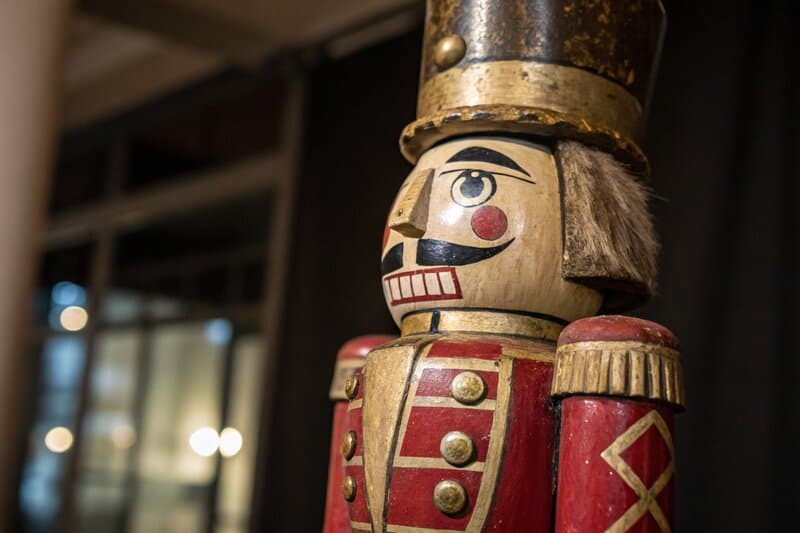
Okay so here is a confession: I have broken more nutcracker jaws than I am proud of.
In my defense, I was young, and the walnut was very hard, and nobody told me that you are not supposed to actually use the decorative ones for cracking nuts. Apparently there is a difference between a "functional nutcracker" and a "decorative nutcracker," and I learned that difference the hard way when King Friedrich the Third lost his lower jaw on Christmas morning 2019.
But here is the thing -- even functional nutcrackers break sometimes. And when I started asking WHY they break, I fell down this amazing rabbit hole of physics and wood science and lever mechanics that I am now going to drag you into. You're welcome.
The Lever: Your Nutcracker Is a Simple Machine
Did you know that a nutcracker is officially a Class 2 lever? Same category as a wheelbarrow, a bottle opener, and a pair of nail clippers. Seriously. Your fancy hand-painted Erzgebirge king is, from an engineering standpoint, the same thing as the tool you use to pop the cap off a soda bottle.
Here is how it works. A lever has three parts: the fulcrum (the pivot point), the effort (where you push), and the load (what you are trying to move or crack). In a nutcracker, the fulcrum is the pivot pin at the back of the head. The effort is the lever you press with your thumb. The load is the nut sitting between the jaws.
The beauty of a Class 2 lever is mechanical advantage. Because the effort arm (from the pivot to where your thumb pushes) is longer than the load arm (from the pivot to where the nut sits), you can crack something much harder than your thumb could crush on its own. The ratio varies by design, but a typical nutcracker gives you a mechanical advantage of about 3:1 to 5:1. That means if you push with 10 pounds of force on the lever, the jaws deliver 30 to 50 pounds of force on the nut.
Which is great for walnuts. Not so great for the nutcracker's jaw.
Why the Jaw Is the Weak Point
The jaws of a nutcracker are the thinnest part of the entire figure. Think about it -- the body is a solid cylinder of wood, maybe 8 or 10 centimeters in diameter. The head is a solid carved block. But the jaw? The jaw is a thin piece of wood, maybe 2 centimeters wide and less than a centimeter thick, that has to absorb all that amplified force every time you crack a nut.
And it does not just have to absorb the force. It has to absorb the SHOCK. When a nut cracks, the resistance drops to zero in an instant, and the jaw slams forward with whatever force was left in the system. That sudden impact -- engineers call it an impulse load -- is way more damaging than a steady push. It is the difference between leaning on a door and kicking it.
Now here is the part that really got me: the jaw breaks in specific, predictable ways, and the way it breaks tells you exactly what went wrong.
Grain Direction: The Secret Villain
Wood is not a uniform material. It has grain -- long fibers running in one direction, like a bundle of straws glued together. Wood is incredibly strong along the grain (try snapping a stick lengthwise -- nearly impossible) and incredibly weak across the grain (try snapping it sideways -- easy).
In a well-made nutcracker, the grain of the jaw piece runs horizontally, from left to right. This means the cracking force is applied perpendicular to the grain, and the grain fibers resist it by working in tension -- stretching slightly rather than separating. The wood flexes. The nut cracks. Everyone is happy.
In a poorly made nutcracker -- and this is where mass-produced nutcrackers fail spectacularly -- the grain runs vertically, from top to bottom. When force is applied, it pushes directly along the grain fibers, which can split apart like pulling straws out of a bundle. The jaw does not flex. It cleaves. And you are left holding two pieces of a nutcracker and a very smug walnut.
Check your nutcracker's jaw right now. Look at the wood grain on the sides. If the lines run horizontally, parallel to the jaw's length, you are fine. If they run vertically, perpendicular to the jaw's length -- be gentle with it. Or better yet, use a different nutcracker for actual nuts and let that one be decorative.
The Pivot Pin Problem
The other common failure point is the pivot pin -- the small dowel or metal pin that holds the jaw's lever to the back of the head. The pivot takes rotational stress every time the jaw opens and closes. Over years, the hole in the wood around the pin gradually widens. The fit loosens. The jaw develops lateral play -- it wobbles side to side. And eventually, the hole becomes large enough that the pin pulls through, and the entire jaw mechanism falls apart.
This is a fatigue failure, and it happens faster in dry conditions. Wood shrinks as it loses moisture. If your nutcracker lives on a mantelpiece above a radiator, or in a centrally heated room with very low humidity, the wood is slowly drying out and shrinking year by year. The pivot hole expands. The glue joints weaken. Parts that were tight when the figure was made become loose over time.
This is also why nutcrackers imported from Germany sometimes develop problems after a few winters in American homes. The humidity levels in the Erzgebirge workshops -- where the air is mountain-cool and moderately humid -- are very different from the dry, heated air of a typical American living room in January. The wood adjusts, and not always gracefully.
The Nut That Fights Back
Not all nuts are created equal, and the nut you put in the jaw matters enormously.
A walnut in its shell requires about 30 to 50 pounds of force to crack. An almond needs about 20 to 35. A hazelnut, 15 to 25. A pecan, about 20 to 30. These are the nuts that a properly constructed nutcracker can handle without complaint.
A Brazil nut, on the other hand, can require up to 70 pounds of force. A macadamia nut -- the tank of the nut world -- can require over 300 pounds. Do NOT put a macadamia nut in a decorative nutcracker. Do not put a macadamia nut in a functional nutcracker. A macadamia nut requires a vise, or a dedicated macadamia cracker, or a small miracle.
Here is a fun fact: the hardness of a nutshell is not just about thickness. It is about the mineral content. Macadamia shells contain high levels of lignin and cellulose arranged in a cross-hatched microstructure that distributes force in every direction simultaneously. The shell is essentially a natural composite material -- like fiberglass, but made of plant cells. Your nutcracker was not designed to fight fiberglass.
How to Fix a Broken Jaw
Okay so let us say the worst has happened. You have a beloved nutcracker with a broken jaw. What do you do?
First: do not use superglue. I know, I know -- it is right there in the drawer and it says "bonds wood" on the label. But cyanoacrylate (superglue) creates a rigid, brittle bond that will snap again the next time the jaw takes any stress. You need a flexible bond for a moving part.
For a clean break -- where the jaw snapped into two pieces that fit back together -- use wood glue. Specifically, a PVA wood glue like Titebond Original. Apply a thin, even layer to both surfaces, press them together, and clamp gently for at least 30 minutes. Let it cure for 24 hours before using the jaw. A PVA bond on a clean break in linden wood will actually be stronger than the surrounding wood -- the glue penetrates the fibers and creates a reinforced zone.
For a pivot pin failure -- where the hole has widened and the pin falls out -- you need to rebuild the hole. Take a toothpick, dip it in wood glue, and pack it into the widened hole alongside the original pin. The toothpick fills the gap, and the glue secures everything. Let it cure for 24 hours. If the hole is really blown out, drill it out to the next size up and insert a slightly larger dowel as the new pin.
For a jaw that has broken off entirely -- where the tang (the part of the jaw that extends into the head) has snapped -- this is a more serious repair. You will need to carve or whittle a new tang from a small piece of hardwood (maple or birch work well), glue it to the jaw piece, drill a new channel into the head, and reassemble the mechanism. This is doable if you are handy, but if the nutcracker has significant value -- either monetary or sentimental -- consider finding a restoration specialist. There are woodworkers who specialize in Erzgebirge restoration, and they can rebuild a jaw mechanism that functions as well as the original.
Prevention: How to Keep Your Jaw Intact
The best repair is the one you never have to make. Here is how to keep your nutcracker's jaw healthy for decades:
Humidity is your friend. Keep your nutcracker in a room with moderate humidity -- 40 to 60 percent relative humidity is ideal. If you live in a dry climate or heat your home aggressively in winter, consider a small humidifier in the room where your nutcrackers live. The wood will thank you.
If you use your nutcracker for actual nuts, choose your nuts wisely. Walnuts, hazelnuts, pecans, and almonds are fair game. Brazil nuts are pushing it. Macadamia nuts are an act of war against your nutcracker.
Operate the lever gently. Do not slam it. Apply steady, increasing pressure until the nut cracks, then release slowly. The impulse load from slamming the jaw closed is what causes most mechanical failures.
And if your nutcracker is decorative -- the hand-painted, rabbit-fur-bearded kind from a workshop in Seiffen -- do not use it for nuts at all. Use it for what it was actually designed for: looking magnificent on a shelf and staring at you with those big, round eyes like it knows something you do not.
The Engineering Is the Story
Here is what I love about all of this. A nutcracker looks like a folk art decoration -- a cute painted figure in a soldier's uniform. But inside, it is a machine. A real, working machine with a lever and a fulcrum and a mechanical advantage ratio and all the physics that go with it. The Erzgebirge carvers who designed this thing three hundred years ago were not just artists. They were engineers. They understood force and material and stress without having the vocabulary for any of it. They just knew what worked, because they tested it with actual nuts, and the ones that broke got redesigned, and the ones that held became the tradition.
That is pretty cool, right? If you know something even wilder about The Nutcracker, tell us. I bet you can't top that one. (But seriously, try.)