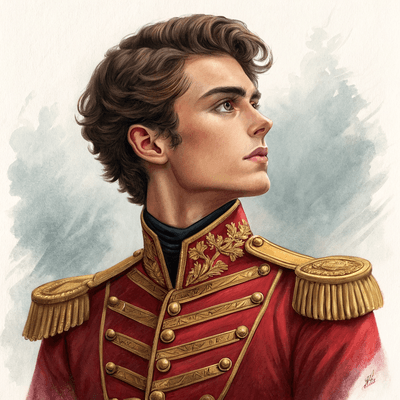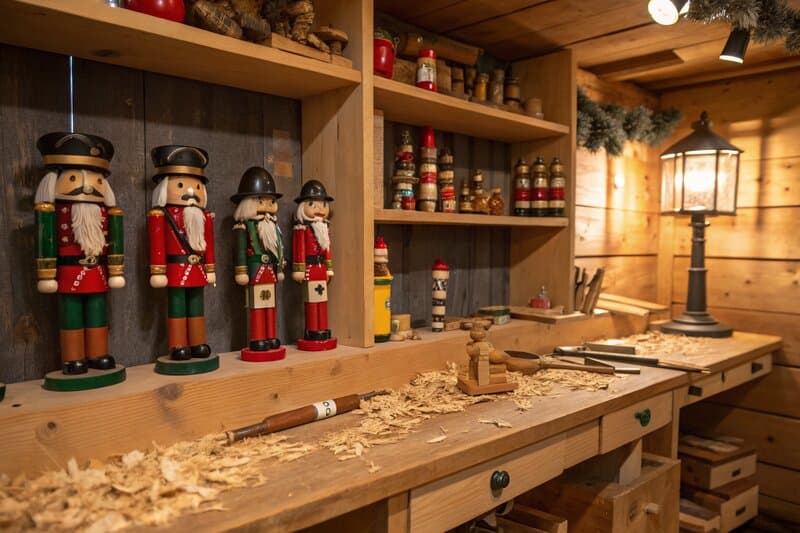
The party scene in Act I of The Nutcracker is, for most audiences, a charming tableau -- well-dressed families, excited children, a beautifully decorated tree. It is a stage picture designed to evoke warmth and festivity before the strangeness of the battle and the journey to come.
But for those who know what they are looking at, the party scene is also a document. A carefully observed reconstruction -- filtered through Hoffmann's writing, Dumas's adaptation, and Tchaikovsky's musical imagination -- of what a prosperous German household's Christmas Eve actually looked like in the early 19th century. The food on the tables, the drinks in the glasses, the gifts under the tree, the games the children play -- all of these are drawn from real traditions, most of which are still practiced in some form today.
I find this worth examining. Not because the party scene needs explaining, but because the real traditions behind it are richer, more specific, and more interesting than the generic "old-fashioned Christmas party" that most productions present.
The Stahlbaum Household
Hoffmann set his original story in a prosperous household in Nuremberg -- or, more precisely, in the kind of household that a successful court councillor (Medizinalrat, in the original) would maintain. The Stahlbaums are upper-middle class: wealthy enough for servants, fine furniture, and imported luxuries, but not aristocratic. They are the professional class of early 19th-century Germany -- educated, cultured, and keenly aware of their social position.
This matters because the Christmas Eve celebration in such a household followed specific conventions. The Stahlbaum party was not informal. It was Heiligabend -- Holy Evening -- and it was the culmination of a season of preparation that began four Sundays earlier with Advent. Every element of the evening was deliberate, from the timing of the meal to the arrangement of the gifts to the specific foods served.
The tree itself was central. The German Christmas tree -- the Tannenbaum -- had been established as a bourgeois tradition by the early 19th century, though it was not yet universal. In a household like the Stahlbaums', the tree would have been set up in a separate room, decorated in secret by the parents, and revealed to the children only on Christmas Eve. This is the moment that Hoffmann describes and that the ballet stages: the doors open, the children rush in, and the tree is revealed in its full glory.
The decorations on a Tannenbaum of this period were edible as much as ornamental. Sugar-coated almonds, marzipan figures, gingerbread cookies, gilded walnuts, and small apples were hung from the branches alongside candles (real candles, wax tapers secured with metal clips -- a practice that caused enough house fires that it was eventually displaced by electric lights). Tinsel, introduced in the early 19th century, was made from real silver -- thin strips hammered and cut by hand, prohibitively expensive by modern standards.
The Table
The Christmas Eve meal in a German household of this period was not the heavy feast that the English-speaking world associates with Christmas dinner. That celebration -- the goose, the roast, the plum pudding -- belonged to Christmas Day. Heiligabend was a lighter affair, though "lighter" is relative.
The meal typically began with soup. In northern Germany, this was often a clear broth with dumplings or noodles. In Saxony and Thuringia -- the regions nearest the Erzgebirge -- a potato soup was common, sometimes enriched with sausage or bacon. In Catholic regions, the meal was explicitly meatless: fish (particularly carp), potato dishes, and dried fruit compotes.
The Stahlbaums, as a prosperous Protestant family in Nuremberg (a Franconian city with its own culinary traditions), would likely have served a more elaborate spread. A typical Nuremberg Christmas Eve table in the early 19th century might include Bratwurst (the small, distinctive Nuremberg sausages that are still a Christmas market staple), Kartoffelsalat (potato salad, served warm with a vinegar dressing), Sauerkraut, smoked meats, and an assortment of breads.
Dessert was the centerpiece. Lebkuchen -- the spiced gingerbread for which Nuremberg was and remains famous -- would have been unavoidable. The city had regulated Lebkuchen production since the 15th century through a guild system, and by Hoffmann's time, Nuremberg Lebkuchen was an internationally traded luxury. Stollen -- the dense, fruit-studded bread dusted with powdered sugar -- was another standard, though its origins are in Dresden rather than Nuremberg. Marzipan, which appears throughout Hoffmann's story (the Marzipan Castle, the sweets of the Land of Sweets), was a real and expensive confection, made from ground almonds and sugar, often molded into elaborate shapes.
The Wine
Wine was the drink of the Christmas Eve table, and the choice of wine was not arbitrary.
Germany's wine regions -- the Mosel, the Rheingau, the Franken, the Pfalz -- produced predominantly white wines in the early 19th century, as they do today. In Nuremberg, which sits in the Franken region, the local wine would have been Frankenwein -- a dry white wine, typically Silvaner or Muller-Thurgau, served in the distinctive Bocksbeutel, a flattened, flask-shaped bottle that remains the region's trademark.
But the most distinctive drink of a German Christmas Eve was not still wine. It was Gluhwein -- mulled wine, heated with spices and sugar and served warm. Gluhwein has been documented in German-speaking regions since at least the 14th century, and by the 19th century, it was inseparable from the Christmas season. The standard recipe -- red wine heated with cinnamon, cloves, star anise, orange peel, and sugar -- has changed remarkably little in five hundred years.
In wealthier households, a more elaborate variation called Feuerzangenbowle might appear. This spectacular drink involves a cone of sugar soaked in rum, placed over a pot of mulled wine, and set alight. The burning rum caramelizes the sugar, which drips into the wine below, producing a drink that is as theatrical as it is intoxicating. Whether the Stahlbaums served Feuerzangenbowle is a matter of speculation, but a man like Drosselmeyer -- a theatrical figure by nature -- would have appreciated the performance.
For the children, there would have been Kinderpunsch -- a non-alcoholic warm drink made from fruit juice, spices, and sugar, designed to let the young participate in the ritual of warm drinks without the wine. This tradition persists at German Christmas markets today, where Kinderpunsch stands sit alongside the Gluhwein vendors.
The Gifts
The gift-giving tradition depicted in the Nutcracker -- Drosselmeyer's dramatic presentation of mechanical toys -- reflects a real practice, though Hoffmann's version is characteristically exaggerated.
In a German household of this period, gifts were presented on Christmas Eve, not Christmas morning. They were arranged on a table (the Gabentisch) beneath or beside the tree, often with each family member's gifts grouped together. The gifts for children were typically handmade or locally produced: dolls, wooden toys, books, and practical items such as clothing and school supplies.
Mechanical toys -- the automata that Hoffmann describes in such unsettling detail -- were real luxury items. German and Swiss toymakers produced clockwork figures, musical boxes, and mechanical scenes that were expensive, elaborate, and genuinely impressive. A wealthy godfather like Drosselmeyer, who in Hoffmann's story is also a skilled clockmaker, would have had both the means and the expertise to procure such gifts.
The nutcracker itself, as a gift, occupies a middle position. It was not a luxury item on the order of a clockwork automaton, but it was more than a simple toy. A well-made decorative nutcracker from the Erzgebirge represented genuine craftsmanship and would have been a considered purchase -- a gift with weight, both literal and symbolic.
What Productions Get Wrong
Most productions of The Nutcracker present the party scene as a generic period celebration -- pretty costumes, polite dancing, a general atmosphere of Victorian or Biedermeier festivity. This is not wrong, exactly, but it misses the specificity that makes the scene come alive.
The food is often absent or purely decorative -- plastic grapes on a platter, a painted cake that no one eats. The drinks are invisible. The gifts are standardized. The cultural details that would root the scene in a specific time and place are smoothed into a generalized nostalgia.
A few productions have taken the opposite approach, and the results are striking. The Hamburg Ballet's production, under John Neumeier, is noted for its attention to historical detail in the party scene -- the table settings, the food, the servant's livery, the specific style of dress appropriate to the period and social class. The Royal Ballet's recent production has similarly invested in period accuracy, consulting with historians to ensure that the Stahlbaum household looks like what it would have actually looked like.
The effect is not pedantry. It is immersion. When the party scene feels real -- when the food looks edible, the wine looks drinkable, the gifts look chosen -- the audience enters the world more fully. And when the world breaks -- when the clock strikes midnight and the mice appear -- the rupture is more shocking because the reality it disrupts was more convincing.
The Table We Set
I think about the Stahlbaum Christmas table sometimes because it represents something specific: a moment when a family gathered and the ordinary rituals of food and drink and gift-giving created the conditions for something extraordinary to happen.
Hoffmann understood this. His story does not begin with magic. It begins with a party -- with soup and wine and Lebkuchen and children impatient for their gifts and adults slightly too merry on Gluhwein and candles flickering on a tree. The magic arrives only after the domestic scene is fully established. The extraordinariness depends on the ordinariness that precedes it.
This is true off the stage as well. The reason The Nutcracker resonates is not that it transports us to a fantastical world. It is that it starts in a world we recognize -- a family at Christmas, gathered around a table, sharing the oldest rituals of the season -- and shows us that the threshold between the ordinary and the extraordinary is thinner than we thought.
Every Christmas Eve, in households around the world, families set tables and pour drinks and exchange gifts and keep traditions that their grandparents kept before them. They are setting the scene. They are building the Stahlbaum parlor in their own living rooms. And if the tree does not literally grow, and the soldiers do not literally march, the magic is no less real for being invisible.
A nutcracker carved by hand carries something a factory cannot replicate. Not just the marks of the chisel, but the patience of the person who held it. That is worth protecting.