On the evening of December 18, 1892, at the Imperial Mariinsky Theatre in St. Petersburg, a ballet premiered that would eventually become the most performed theatrical work in the Western world. The audience that night had no way of knowing this. They were, by most accounts, profoundly unimpressed.
The ballet was The Nutcracker. And the story of its disastrous first night contains secrets about the production's design, the politics of the Imperial Theatres, and the quiet sabotage of ambition by circumstance -- secrets that have been largely forgotten, buried under a century of success.
Permit me to unearth them.
The Commission
To understand what went wrong, you must first understand who was in the room.
Ivan Vsevolozhsky, the director of the Imperial Theatres, conceived the project. Vsevolozhsky was an unusual figure -- an aristocrat, an amateur artist, and a cultural impresario who personally designed costumes for many of the productions he oversaw. He had previously commissioned Tchaikovsky and Petipa's The Sleeping Beauty in 1890, which was a triumph. Emboldened, he proposed a double bill for the 1892 season: a one-act opera, Iolanta, paired with a two-act ballet based on the Nutcracker story.
The commission went to the same team: Tchaikovsky for the music, Marius Petipa for the choreography. The source material was Alexandre Dumas's French adaptation of Hoffmann's tale, which Petipa selected for its theatrical potential. The original Hoffmann was too dark, too strange, too embedded in its own literary consciousness. Dumas had made it stageable.
Petipa, who was seventy-four years old and at the height of his prestige, prepared a detailed scenario -- a scene-by-scene, sometimes bar-by-bar description of what he wanted the music to do. He specified tempos, dynamics, moods, and durations with the precision of an architect submitting blueprints. Tchaikovsky, accustomed to this arrangement from The Sleeping Beauty, accepted the instructions, though his private correspondence reveals frustration with what he perceived as creative constraints.
"The scenario does not interest me at all," Tchaikovsky wrote to his brother Modest. "The chief thing I need is to see the stage production."
He would not get the production he imagined.
Petipa's Collapse
In the autumn of 1892, with rehearsals approaching, Marius Petipa fell seriously ill. The exact nature of his illness has been variously described by historians as a severe cold, a nervous breakdown, or a more prolonged condition that had been building for months. Whatever its cause, the effect was decisive: Petipa could not complete the choreography.
The task fell to Lev Ivanov, Petipa's assistant and second ballet master at the Mariinsky. Ivanov was talented -- he would later choreograph the iconic white acts of Swan Lake -- but he was not Petipa. He lacked Petipa's authority with the dancers, his experience with large-scale productions, and, crucially, his relationship with Tchaikovsky.
Ivanov worked from Petipa's notes, which were detailed for Act I but increasingly sketchy for Act II. The divertissement dances -- the Spanish, Arabian, Chinese, Russian, and others -- had been outlined in Petipa's scenario, but the actual choreographic content was left largely to Ivanov's invention. This meant that the second act, which was already the ballet's structural weak point, was being choreographed by a substitute working under extreme time pressure.
Here is a detail the standard histories mention only in passing: Ivanov had approximately six weeks to stage the entire ballet. For a full-length work with a large cast, complex scenic effects, and a score he was hearing for the first time, this was not merely challenging. It was barely feasible.
The Scenic Spectacle
But here is where the story takes a turn that most accounts overlook entirely.
The physical production of the 1892 Nutcracker was, by the standards of the Imperial Theatres, extraordinary. Vsevolozhsky and his design team approached it with an ambition that the choreographic troubles did not diminish. The scenic design was entrusted to Konstantin Ivanov (no relation to Lev), one of the Mariinsky's principal set designers, with additional work by the theater's technical director, Mikhail Bocharov.
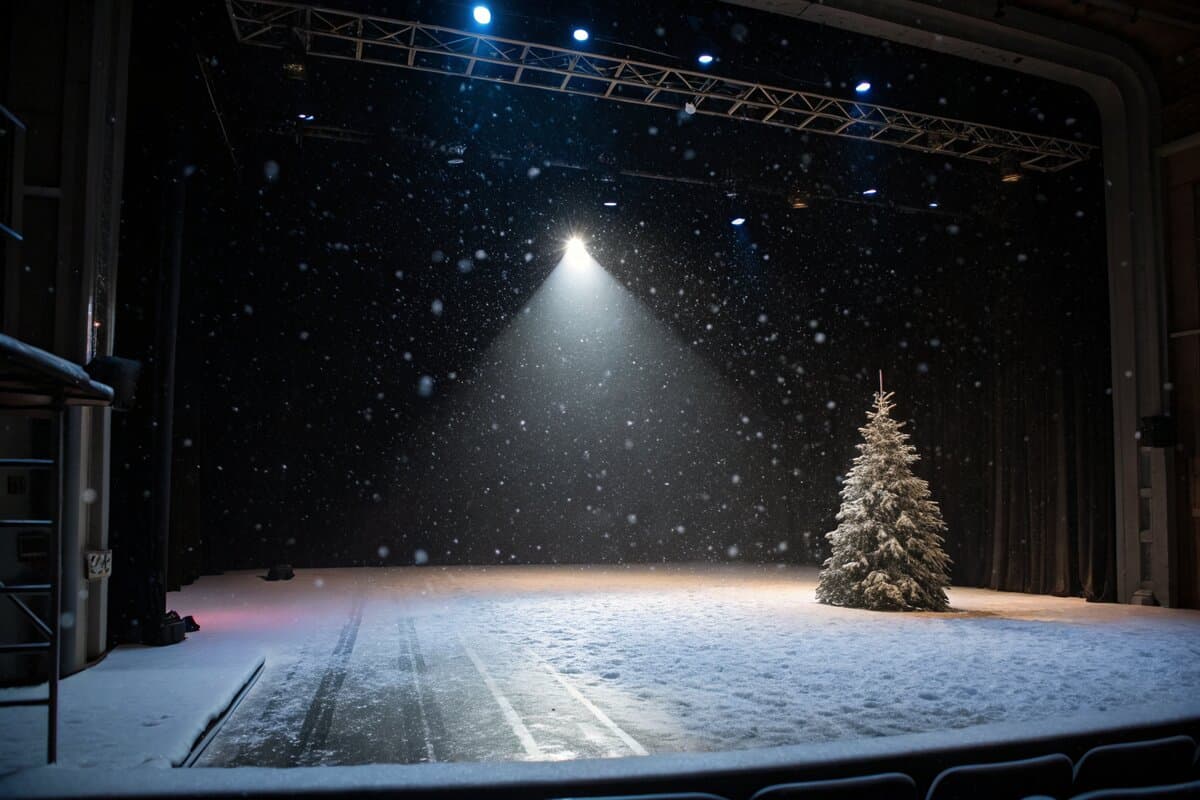
Act I featured a full-scale reproduction of a German bourgeois parlor, complete with a functioning Christmas tree. The tree was the production's central scenic effect. Through a combination of stage machinery and forced perspective, the tree was designed to appear to grow to enormous proportions as Clara shrank beneath it -- an illusion achieved by simultaneously raising the tree set piece and lowering the floor platform on which the child performer stood. The mechanism was innovative for its time and reportedly cost more to build than the scenery for the entire first act of The Sleeping Beauty.
Act II presented the Land of Sweets. Here, Vsevolozhsky's personal involvement was most visible. He designed many of the costumes himself, drawing on his extensive knowledge of historical dress and his admiration for French decorative arts. The Land of Sweets was conceived not as a generic fantasy but as a specific aesthetic environment: a palace of confectionery rendered in the rococo style, with sugar-spun columns, candy-colored draperies, and a throne for the Sugar Plum Fairy that was built from layers of painted gauze to suggest transparency.
The snow scene -- the Waltz of the Snowflakes that closes Act I -- employed a technique that the Mariinsky had been developing for several seasons. Paper snow was released from the flies while hidden fans created air currents to simulate wind. What made the 1892 production unusual was the scale: contemporary accounts describe an unprecedented quantity of artificial snow, combined with lighting effects that dimmed and brightened to suggest shifting cloud cover. The Mariinsky's gas-lit stage (electricity was still being installed in sections) gave the snow a warm, flickering quality that modern electric lighting cannot replicate.
These details have been largely lost to history, for a simple reason: nobody wrote about them. The critics were too busy being disappointed by everything else.
Opening Night
The double bill of Iolanta and The Nutcracker premiered on December 18, 1892. The audience was the standard Mariinsky subscription crowd -- aristocrats, military officers, cultural figures, and their families. Expectations were high. The Sleeping Beauty, two years earlier, had been a sensation.
What they received was a ballet that seemed, to their eyes, incomplete.
The critical response was withering. The newspaper Peterburgskaya Gazeta published a review noting that "the production has been staged with great luxury, but the ballet itself turned out to be rather monotonous." The critic for Novoe Vremya was blunter: "For dancers there is rather little in it, for the art of ballet, almost nothing, and for the artistic fate of our first ballet theater, it is a step backward." The Sankt-Peterburgskie Vedomosti complained that the second act was "merely a series of sweets" and that the ballet lacked the dramatic substance of Petipa's previous works.
Several critics noted, with varying degrees of politeness, that the choreography appeared rushed. The children in Act I -- local students from the Imperial Theatre School -- were charming but technically limited. The adult dancers had been given relatively little to do. The grand pas de deux for the Sugar Plum Fairy and the Cavalier, which should have been the climax of the evening, was considered adequate but not revelatory.
Tchaikovsky's score fared somewhat better. The Nutcracker Suite -- the eight-movement orchestral selection he had extracted and premiered in a concert six months earlier -- had already been warmly received. Several critics acknowledged the beauty of the music while lamenting that the staging did not do it justice.
But here is the detail that haunts me, the secret that the premiere's critics did not possess the vocabulary to articulate: the scenic production was remarkable. The tree grew. The snow fell. The Land of Sweets shimmered. The physical environment of the ballet -- the world that Vsevolozhsky and his designers had built -- was achieving something that the choreography, for all its limitations, was not. It was creating atmosphere.
What Was Lost
The 1892 production continued in the Mariinsky's repertoire, but it was not considered a success. It was revived periodically, sometimes with revisions, but it never achieved the prestige of The Sleeping Beauty or Swan Lake. When the Mariinsky revived it in 1923 under new Soviet management, the production had already changed significantly, with new choreography by Fedor Lopukhov that moved further from the 1892 original.
And here is what was lost: the specific scenic vision of the original production. The set designs, the costume sketches by Vsevolozhsky, the technical plans for the tree mechanism and the snow effects -- much of this material was dispersed, destroyed, or simply neglected over the following decades. The Russian Revolution, two world wars, and the Soviet reorganization of the Imperial Theatres all took their toll on the archival record.
Some costume designs by Vsevolozhsky survive in the collections of the St. Petersburg Theatre Museum. They are exquisite -- detailed watercolors showing costumes that blend historical accuracy with confectionary whimsy. The Sugar Plum Fairy's costume, in Vsevolozhsky's original design, featured layers of tulle embedded with what appear to be actual sugar crystals, though whether these were real or simulated remains debated by textile historians. The Mouse King's costume included seven articulated heads -- each with its own miniature crown -- mounted on a mechanical framework that allowed the performer to move all seven heads simultaneously.
These designs suggest a production of far greater visual ambition than the critical reception acknowledged. The reviewers were judging the choreography and the drama. They were not, in any systematic way, evaluating the visual environment -- the lighting, the scenic effects, the costume design -- as a distinct artistic achievement. Design criticism, as a formal practice, did not yet exist in the Russian ballet press of the 1890s.
What the critics missed, I believe, is what we would now recognize as immersive theater. The 1892 Nutcracker may have been choreographically incomplete, but it was scenically visionary. It was attempting to create a world -- a fully realized sensory environment that audiences did not simply watch but entered. The growing tree, the falling snow, the rococo confection of the Land of Sweets -- these were not backdrops. They were the experience.
The Secret of the Winter King
You see, my dear reader, The Nutcracker's premiere was not a failure. It was a misidentification. The critics evaluated it as a ballet and found it wanting. But the production that Vsevolozhsky built was something the vocabulary of 1892 could not name -- a total theatrical environment, a designed world, an experience that succeeded on dimensions the critics were not measuring.
It took a century for the art form to catch up. Today, when we speak of immersive theater, of production design as a primary artistic discipline, of the audience's sensory experience as something separate from and equal to the narrative content -- we are describing, however unknowingly, the ambition of that first Nutcracker.
The ballet that was panned in 1892 was not the ballet that conquered the world. Balanchine's 1954 production, the Baryshnikov television broadcast of 1977, the hundreds of regional productions that followed -- these are descendants, not copies. But the impulse that drives them -- the desire to create a world you can step into, a place where trees grow and snow falls and the ordinary rules are suspended -- that impulse was there on opening night, in a theater lit by gas lamps, before an audience that did not quite understand what they were seeing.
They called it a disappointment. I call it a beginning.
But that, as they say, is a story for another evening. The candles are low, and I have kept you long enough. For now.